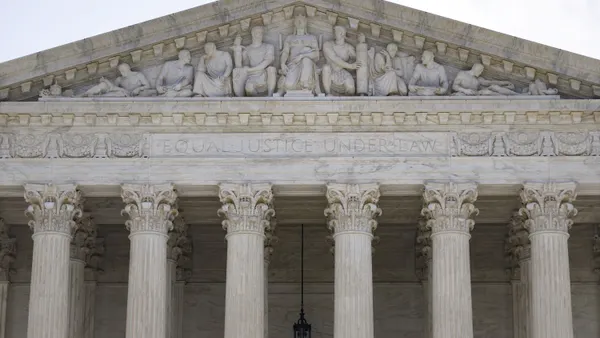
The 10th U.S. Circuit Court of Appeals on Wednesday upheld an Oklahoma curriculum restriction law, saying that nothing in the language prohibits educators from discussing race-related, sexist or oppressive concepts “in the abstract or in connection with historical or popular figures." The state law is one of many nationwide seeking to prohibit "divisive concepts."
"The statute’s language does not support such a broad interpretation," stated the ruling, issued by a divided three-judge panel.
The lawsuit was filed against Oklahoma's H.B. 1775 in 2021, when similar laws preventing "divisive concepts" in the classroom were picking up steam and spreading to Republican-led states nationwide. The Oklahoma statute challenged by the lawsuit prohibited eight "concepts," including teaching that "an individual, by virtue of his or her race or sex, is inherently racist, sexist or oppressive, whether consciously or unconsciously."
The decision this week overturned a district court order barring the state from enforcing parts of the law, including two of the eight prohibited concepts, while the lawsuit was pending. The case will continue in district court.
Civil rights groups challenged the law and sued Oklahoma Attorney General Gentner Drummond and state education leaders, partly on behalf of K-12 teachers. The complaint said that district administrators removed texts by Black and women authors from their reading lists — including classics like “To Kill a Mockingbird,” “Their Eyes Were Watching God,” “I Know Why the Caged Bird Sings,” and the “Narrative of the Life of Frederick Douglass” — while leaving in place texts by White and male authors.
"Teachers have received guidance to comply with H.B. 1775 by avoiding terms such as 'diversity' and 'white privilege,'" the complaint said, adding that the prohibitions in the Oklahoma statute were "vague" and "overbroad."
A teacher mentioned in the lawsuit, for example, said they canceled plans to introduce information related to current events, such as detention centers at the border, in fear of violating the Oklahoma law, because related issues like systemic racism and implicit bias may make some students "feel discomfort."
However, two judges in the three-judge panel for the 10th Circuit disagreed.
"The K-12 plaintiffs aren’t likely to show that these concepts are vague," they said. "We see no vagueness in any of them."
While the decision overturned a temporary pause on parts of the law, the judges’ interpretation of it means that educators are able to continue teaching concepts they feared would be prohibited by the statute's language, according to the American Civil Liberties Union, one of the groups that filed the lawsuit.
“The majority’s narrow reading of the law means that H.B. 1775 is no longer a barrier to inclusive teaching and honest discussions about race and gender,” said Emerson Sykes, senior staff attorney with ACLU’s Speech, Privacy, and Technology Project, in a Sept. 10 statement.
Michael Pillera, director of the Educational Opportunities Project at the Lawyers’ Committee for Civil Rights Under Law, which also filed the lawsuit, said the opinion means teachers only violate the law if they present an “unqualified racist or sexist assertion” as fact.
However, Drummond, one of the respondents in the lawsuit, also celebrated the decision as "a first-in-the-nation appellate victory" and said the decision clears the way for the state to enforce the law fully, including the two prohibited concepts originally subject to the district court's injunction.
Those were that "an individual should be discriminated against or receive adverse treatment solely or partly because of his or her race or sex" and "members of one race or sex cannot and should not attempt to treat others without respect to race or sex."
Drummond's office said in a Sept. 10 statement that Oklahoma is "the first state in the country to have such a law upheld by a federal appellate court."
A handful of such lawsuits challenging laws similar to Oklahoma's have been filed in recent years and are working their way through the courts nationwide.
According to a study published in 2023 by the University of California, Los Angeles, School of Law, local, state and federal government officials introduced 563 measures in 2021 and 2022 aimed at restricting teaching about race and racism. Out of those, 241 measures were adopted.
UCLA researchers also found that nearly half of the proposed measures adopted language from the now-rescinded Executive Order 13950, which was issued during President Donald Trump's first term in 2020, and 90% of them targeted K-12 schools.
According to Drummond, Oklahoma’s H.B. 1775 is one of more than a dozen state laws modeled after Trump's 2020 executive order.