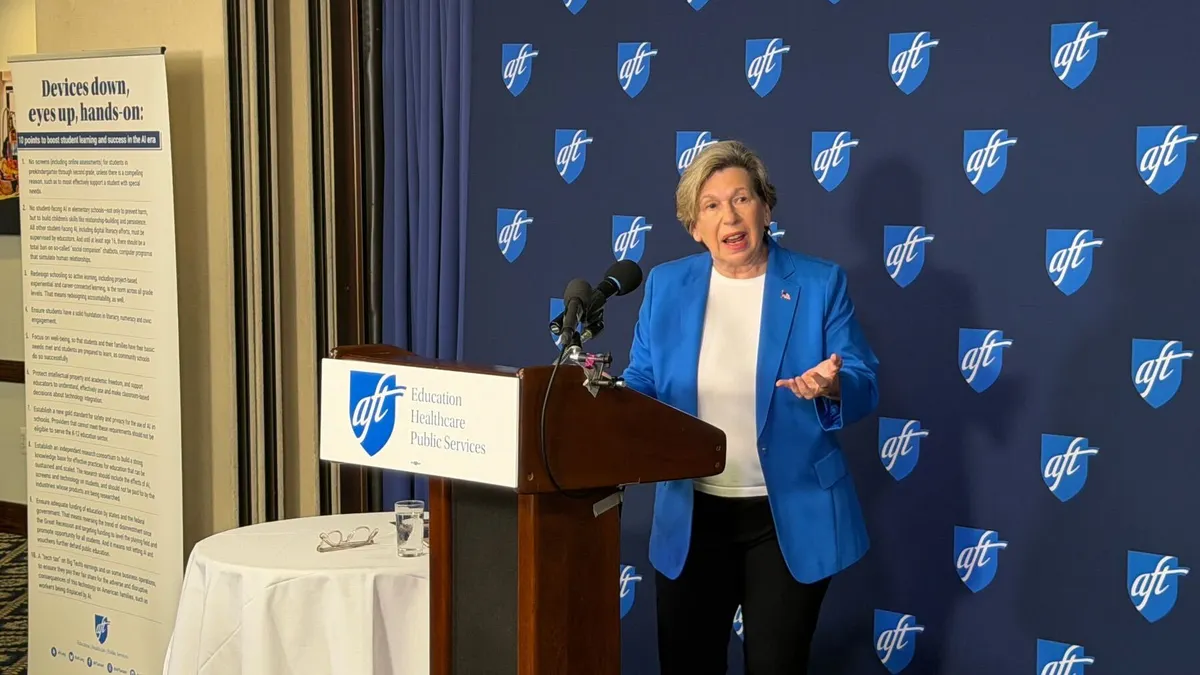
American Federation of Teachers President Randi Weingarten called for a ban on screens in schools for students in preschool through 2nd grade on Wednesday — as well as a prohibition on student-facing artificial intelligence tools in elementary schools.
The call from the leader of the nation’s second-largest teachers union comes amid growing momentum for curbing screen use, ed tech and AI in classrooms nationwide. Weingarten's proposed bans on screens and AI for younger students are part of a broader “Devices down, eyes up, hands-on” 10-point plan from AFT that aims to improve student learning and achievement.
The proposal also says a screen ban for pre-K-2 students should include online assessments — but that "compelling reasons” such as supporting students with special needs could be cause for exceptions.
AFT’s plan reasons that by prohibiting student-facing AI at the elementary level, harm to younger students will be prevented, and they will be better able to build skills like fostering relationships and persistence. Additionally, the plan states that any other student-facing AI in schools such as digital literacy initiatives must be supervised by educators.
“Young people are resilient, but too often the kids are not alright, and a major reason is that they are drowning in tech,” Weingarten said in a Wednesday speech at the National Press Club in Washington, D.C.
Weingarten cited research from Jared Cooney Horvath, a neuroscientist, who has analyzed how reading and math trends shifted after state expansion of ed tech in schools. She added that Horvath found that before large scale adoption of ed tech, 4th and 8th grade scores on the National Assessment of Educational Progress were rising steadily, but after adoption, that trajectory shifted “often sharply downward.”
While “correlation is not causation,” Weingarten said, Horvath has pointed to research suggesting this pattern across states, countries, grade levels, subjects and years.
Weingarten said she’s “not calling for an AI ban or a Chromebook bonfire” and acknowledged that AI is “here to stay.” Still, she said, there needs to be enforceable guardrails on the technology.
Last year, AFT announced the creation of the National Academy for AI Instruction in a $23 million partnership with Microsoft, OpenAI and Anthropic. The no-cost academy aims to train 1 in 10 U.S. teachers to develop AI fluency skills by 2030.
Weingarten said that there has been a lack of federal legislation for safe and responsible AI use. Through its academy, she said AFT is currently negotiating a “gold standard” that would set industry best practices for safety and privacy when implementing AI in schools.
“We’re seeking a binding agreement between America’s K-12 schools and any provider that offers AI-driven services to educators or students,” Weingarten said. “And companies that refuse to abide by such a standard must be prohibited from working in our schools.”