After a tumultuous 2025, education policy and legal experts expect no let-up in 2026. The second Trump administration and its Education Department are continuing to reshape the direction of federal support for K-12, and courts are routinely hearing cases of great consequence for school district policies.
Continual change to the education landscape "makes it very difficult to plan and prepare, and to provide students with the quality public education they deserve," said Sasha Pudelski, director of advocacy for AASA, The School Superintendents Association. "School district leaders are facing mounting uncertainty, and should brace for more in 2026.”
Here are four K-12 legal and policy trends for district leaders to monitor in the coming year.
Uncertainty around federal support
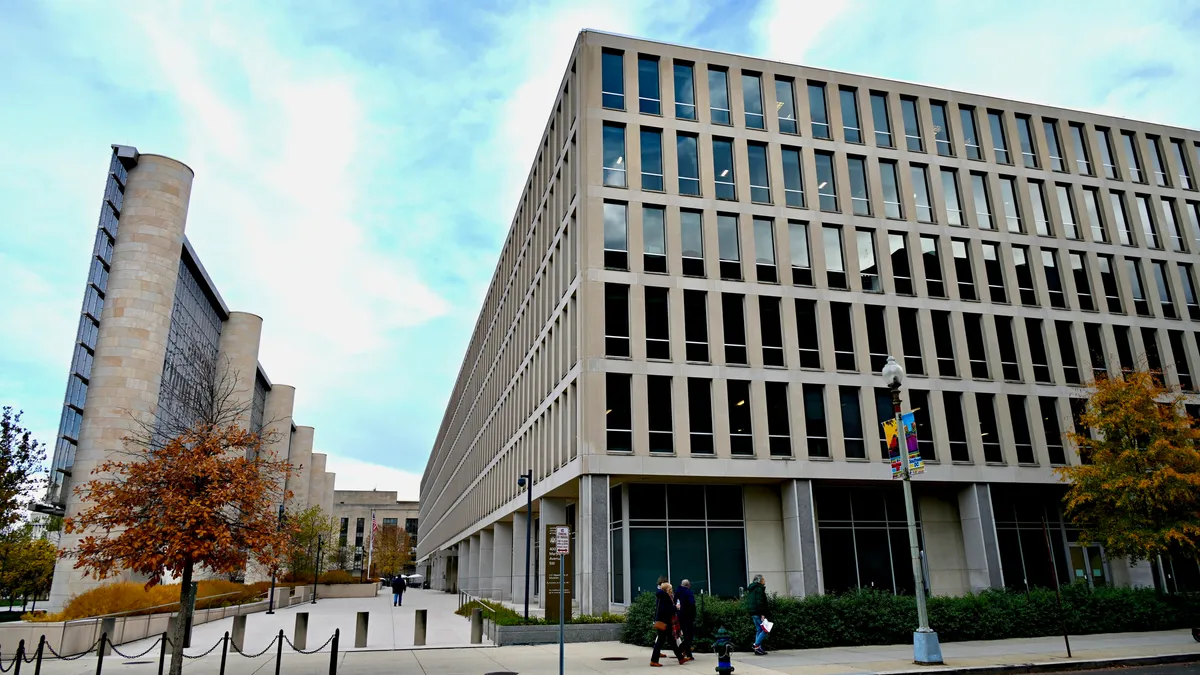
The Trump administration's push to "return education to the states" means that superintendents can expect less federal support and more change in 2026. This ranges from less help with administering the National Assessment of Educational Progress and managing federally funded programs, to unpredictability around the availability of federal funds and the makeup of the U.S. Education Department, education policy experts said.
"Anything that they're used to getting from the federal government, I would expect them to essentially expect less," said Jonathan Collins, assistant professor of political science and education at Columbia University's Teachers College.
Collins said districts in blue states can also anticipate being targeted for policies related to diversity, equity and inclusion — including programs that support diversifying the teacher workforce — as well as LGBTQ+ rights.
"You should expect them to turn up the heat," Collins said of the federal government's crackdown on Title VI and Title IX issues, which bar race- and sex-based discrimination, respectively, in federally funded education programs.
In the past, the federal government typically invoked the statutes to protect underserved students, but the Trump administration has instead used them to target DEI efforts and protections for LGBTQ+ students. "I think the nozzle on the gas is going to change to an even higher level this upcoming year," Collins added.
A bigger religious footprint in public education
Recent years have seen a surge in First Amendment lawsuits related to the religious rights of parents and teachers, especially spurred on by the parental choice movement circling around issues like curriculum and LGBTQ+ culture in schools.
In 2025, for example, the U.S. Supreme Court required a Maryland district to allow curriculum opt-outs for parents who don't want their children exposed to LGBTQ+-related content. That ruling in Mahmoud v. Taylor set legal precedent for other districts' policies on such opt-outs.
In 2026, additional rulings on similar issues are expected to influence district policies, according to education policy experts. For example, lawsuits are pending on LGBTQ+ student pronoun usage and state laws requiring the Ten Commandments to be displayed in classrooms.
Districts, especially those in red states, can expect "to exercise even more authority" over school prayer, teaching of the 10 Commandments, "and just any initiative or program or aspect of schooling that especially caters to Christianity," said Collins. "I think you can expect to see an even bigger upsurge in those kinds of things happening."
Religious-based organizations are also likely to continue pushing — under the mantle of the First Amendment — for the creation of religious public charter schools.
As a result of a deadlock due to Justice Amy Coney Barrett's recusal in one such case, the Supreme Court kept in place an Oklahoma ruling that blocked what would have been the nation's first religious public charter school. However, after that Catholic school's failed launch, another religious charter was proposed for Oklahoma in November — this time by a Jewish organization. Whether that school succeeds, and what it could mean for other efforts to establish religious public schools, will be watched in 2026.
Expansion of right-to-education cases
While right-to-education lawsuits have been a constant in the education finance sector, the "right-to-education" legal argument is expanding to specific subject areas in the classroom, including literacy and civics education. The right to education is guaranteed under almost every state constitution, and it has so far been used routinely by students and advocacy groups to advocate for equitable education funding.
In recent years, that argument has expanded to "right-to-literacy" or "right-to-read" cases, with California and Detroit entering major settlements after students sued.
The legal argument is also being stretched to ensure civics education is taught, said Michael Rebell, executive director for the Center for Educational Equity and a professor of law and educational practice at Columbia University's Teachers College.
In 2025, students applied "the right to education" legal argument to sue for a better civics education in Kentucky, for instance. In 2026, this legal argument could proliferate, Rebell said, with a decision expected any day now in the Kentucky case.
More AI policies and guidance
Following the explosion in the deployment of artificial intelligence across education and countless other sectors in 2025, districts can expect more guidance and policies related to AI tools in 2026, education experts said.
At least 31 states have already issued some kind of AI guidance or framework for schools, according to AI for Education, a for-profit provider of AI literacy training for educators.
However, the legal parameters for using the technology — including such concerns as data rights and privacy protections — still need to be ironed out at the federal level and across states and localities.
"It's kind of the wild, wild west right now," said Collins. "Expect that to also be a big cornerstone of what we see education policy-wise in this upcoming year."




 Dive Awards