
Nearly 10,000 schools across the U.S. were forced to temporarily close due to weather-related incidents this past school year. For school districts, this reflects a growing reality: keeping classrooms safe and operational is no longer just a facilities issue, but a time sensitive challenge hinging on when students return in the fall.
On the first day of school, a classroom should feel ready. Students should be focused on their teacher, not the temperature. They should be able to hear clearly, breathe easily and settle into a routine without distraction.
Maintaining these essential learning conditions is becoming increasingly difficult. When AC, ventilation and power systems fail, the impact can be immediate, putting instructional time at risk. In the 2024–25 school year alone, California students lost 8,789,704 hours of instructional time due to school closures and disruptions linked to extreme weather.
The problem is not a lack of awareness around these aging facilities. It is, quite often, time.
As the new school year starts in 2026, districts have a valuable opportunity to begin planning for facility improvements next summer. Once the school year progresses, there is very little room to do meaningful infrastructure work without disrupting students. Summer becomes the only viable period to act at scale and the time to plan for next summer is right now. Many districts misuse this time by just tackling routine maintenance. Other districts treat it as a strategic window to set the tone for the entire year.
The difference is planning and execution. The most effective efforts begin months in advance, with a clear view of facility performance, energy use and points of failure. From there, priorities are set around what will matter most when students return. For those of us working alongside districts, it requires aligning engineering, procurement and construction into a single plan that can be delivered on a fixed schedule. By the time summer arrives, the planning should already be complete so the work can move quickly and be finished before the first day of school.
At the Santa Paula Unified School District in Southern California, this approach has shaped a multiyear, phased modernization effort. HVAC repairs, equipment replacements and building automation upgrades have been delivered in carefully planned stages, with the most disruptive construction activities intentionally scheduled during the summer months. Using the summer period for major work helps minimize impacts to instruction and daily operations while providing a practical window to complete complex upgrades efficiently.
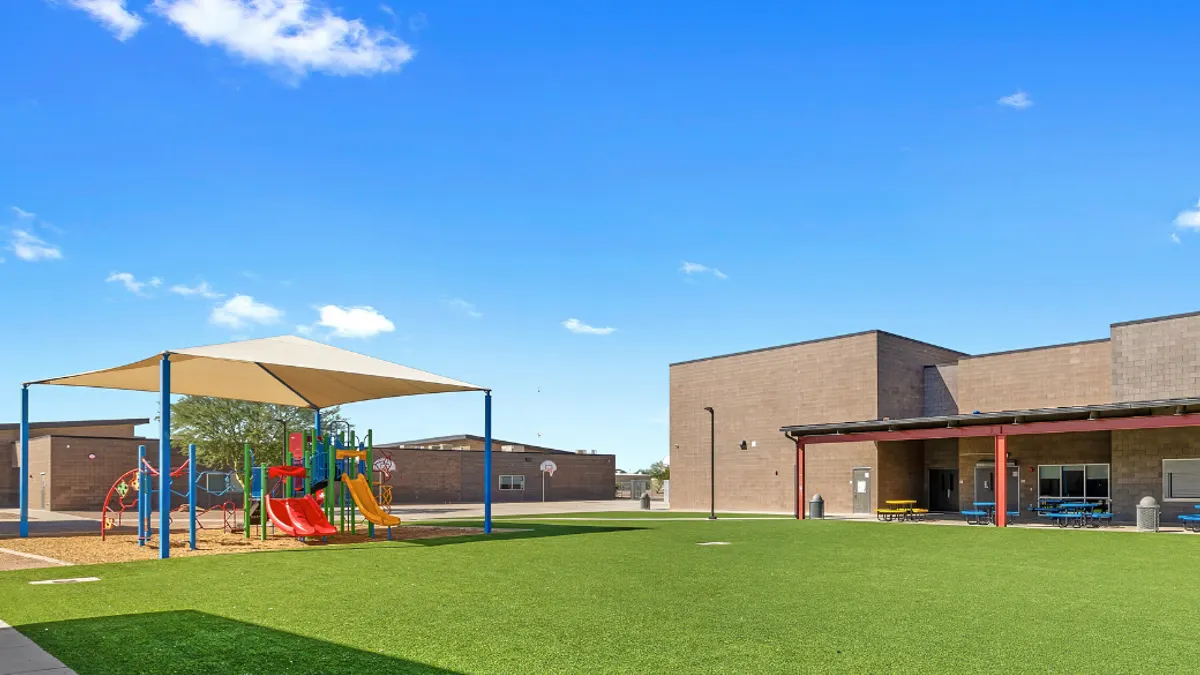
Tempe Elementary School District has taken a similar approach across every break in the academic calendar. Work has included solar PV array installations strategically placed to provide shade to vehicles and school drop off and pickup areas, turf and xeriscaping, window film, irrigation, automation systems and complex electrical integrations. By summer 2026, the final phase of the solar PV array installations will be complete.
The results of these projects are visible in small but meaningful ways. Students arrive to more comfortable, consistent environments from shaded school drop off areas to cooled classrooms ready for learning. Teachers can focus more on instruction, instead of managing classroom conditions. And staff gains confidence in systems that perform reliably when conditions may be at their most challenging. It is easy to treat infrastructure as separate from instruction, but in practice, they are closely linked.
In many districts, the schools with the greatest facility challenges serve the students with the least margin for disruption. Planning now and using summer well is one of the most direct ways to address that imbalance.
School infrastructure is not a background issue. It is part of the learning environment.
As the school year gets underway, now is the time to evaluate facility needs, establish priorities and prepare for the next summer construction season. Districts that begin planning early will be best positioned to use that limited window efficiently, completing critical upgrades before the first bell rings next fall.