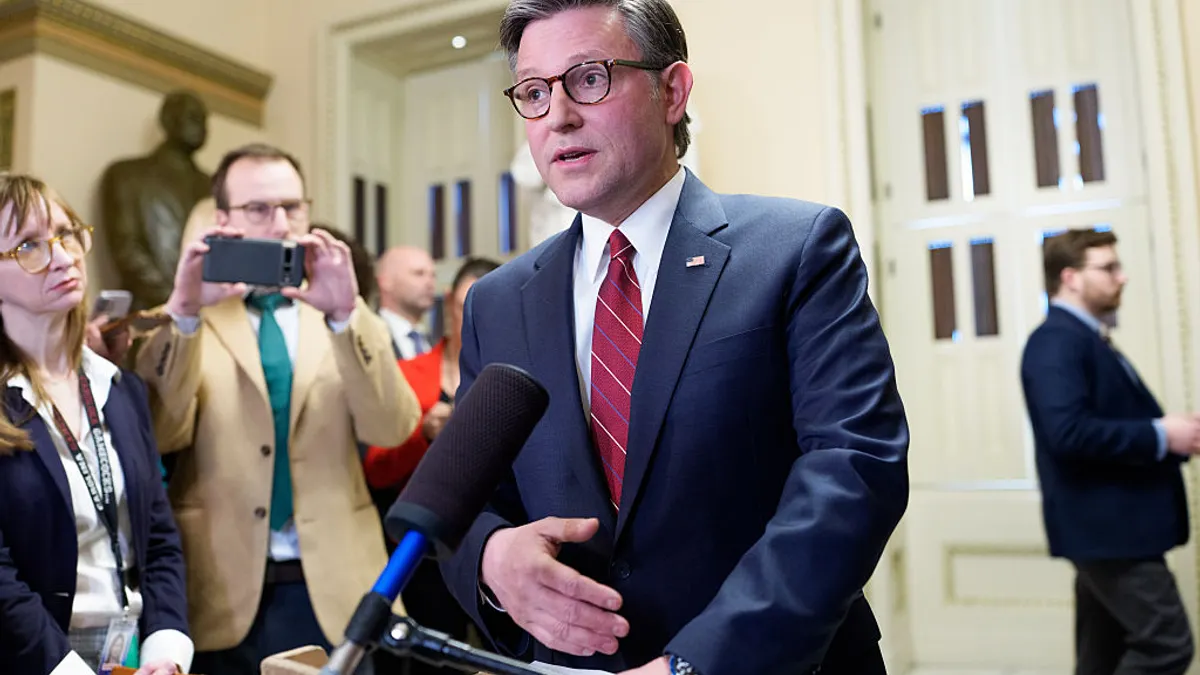
The fiscal year 2026 budget that includes funding for the U.S. Department of Education inched closer toward final approval with the House voting 217-214 Tuesday in favor of the measure. It now heads to President Donald Trump, who is expected to sign it into law.
The budget funds the Education Department at $79 billion through Sept. 30. That's about $217 million above FY 2025 levels. The funding plan also explicitly prevents the Education Department from transferring statutorily required program responsibilities to other federal agencies.
Additionally, the bill requires on-time formula grant funding available to states and districts at levels dictated by Congress in the funding bill. And it adds a new requirement to maintain the Education Department staff at levels necessary to fulfill its statutory responsibilities, including carrying out programs and activities funded in the bill.
The Education Department, along with several other federal agencies, briefly paused operations after Jan. 30 when a continuing resolution lapsed. While the continuing resolution maintained funding at FY 2024 and FY 2025 levels for the Education Department, it did not give the same level of fiscal direction from Congress as annual appropriations bills do.
The Education Department FY 2026 funding plan was included in a consolidated appropriations act along with the budgets for the U.S. departments of Defense; Homeland; Labor, Health and Human Services; Transportation, Housing and Urban Development; and related agencies. However, debate about allocations for federal immigration enforcement under the Department of Homeland Security delayed approval for the full funding package.
House and Senate lawmakers agreed to a two-week continuing resolution for the Department of Homeland Security allocation and to move forward the remaining five appropriations bills, including for the Education Department.
The National Association of Secondary School Principals said in a statement after Tuesday's vote that schools nationwide "avoided cuts to critical resources that serve America's most vulnerable students under the education cuts passed by Congress today, including mental health support, special education services, and opportunities for students in high-poverty districts."
Ronn Nozoe, CEO of NASSP, said in the statement that "this funding lets school leaders focus on students instead of worrying about resources. And that's exactly how it should be. Faithful implementation of these funding levels will be critical so school leaders can count on the resources Congress has provided."
Jodi Grant, executive director of the Afterschool Alliance, also praised the legislation's passage in a statement Tuesday. However, Grant noted that the $1.3 billion allocation for 21st Century Community Learning Centers has not increased since FY 2022, "even as costs associated with running programs have soared."
The Afterschool Alliance is “grateful Congress rejected the Trump administration’s proposal to end dedicated funding for this vitally important initiative, which supports programs that keep kids safe, inspire them to learn, and give working parents peace of mind that their children are safe, supervised, and learning after the school day ends," said Grant.