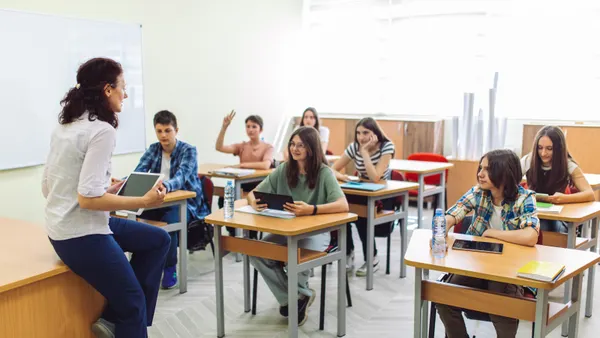
The use of dramatic “improv” techniques in English/language arts classes can spark participation and creativity by making students feel safer about speaking up and ensuring they don’t “overthink” their answers, educators say.
“It gets them on their feet, using their imagination. Imagination feels a little ‘on the ropes’ in our society,” said Christian Goering, professor of curriculum and instruction at the University of Arkansas College of Education and Health Professions. “I’ve never been part of an improv activity in a school that didn’t generate smiles and laughter. Maybe right now, the way school is in our society, that’s more important than ever.”
To Lisa Marie Barker, director of improvisation initiatives at the University of Wisconsin-Madison School of Education, the core tenet of improv is that mistakes are anticipated — and even expected — as the natural byproduct of humans coming together.
“We fail, cheerfully,” she said. “If facilitated effectively, [improv] can have good outcomes. If debriefed well, it can open up conversations related to psychological safety — to save face, preserve our humanity and leverage mistakes as beautiful, natural gifts people are giving to the learning community.”
A former high school English teacher and co-author of “Joyful Literacies in Secondary English Language Arts,” Goering suggests that all teachers should take an improv class as part of their own education, as he did as an undergrad student.
“Being up in front of a group of students, being able to project your voice, and being ready to respond to whatever it is they say — and they say the craziest things — there’s a skill set there,” he said. “There’s a muscle that, as a teacher, I really appreciated and was quick to use.”
Goering said improv has a social aspect that appeals to students, recalling that he got to know fellow students in his college improv class much better than peers in other subjects.
“The dialogic nature of improv — what I say responds to what you said, back and forth — that’s what school should look like,” he said. “It opens up all kinds of doors for understanding and appreciation of differences.”
Improv also builds student agency, Goering said. “You’re going to see students come alive and do things they wouldn’t otherwise do,” he said. “The traditional ‘Yes, and’ activity is a great place to start if a teacher is new to improv and new to the context of using this in your class. … It’s a way to explore things with a lot more depth and a lot more authenticity.”
Barker, who is also executive director of professional learning and community education, or PLACE, at University of Wisconsin, took improv classes while working as a high school English teacher in California.
“I ended up using the principles and practices of improv theater henceforth,” she said, adding that she wrote her dissertation on how improv can help teachers emphasize presence in the orchestration of whole-class discussions.
The use of improv can either be safe or “leave you feeling icky” if mistakes are not seen as welcome and celebrated, and if students aren’t given the opportunity to “save face” when making them, Barker said.
“In an ELA classroom, you can use improv games to imagine characters and places and dialogue that children can use in their writing. That is a home run,” she said. “It can open up conversations about ways children can participate with each other.”
To do so, an ELA teacher should establish group norms after playing a few of those improv games and then asking, “What did those games require of you?” she said. Ideally, the answer is something to the effect of, “Listening closely, building on ideas and laughing.”
“When people feel like they’re part of a community that cares about each other, they can take risks, do important work, and they can show up,” Barker added. “Attendance will be better, children will be ready to rock, see themselves as useful and belonging, and take on leadership roles. That, in and of itself, is engagement.”