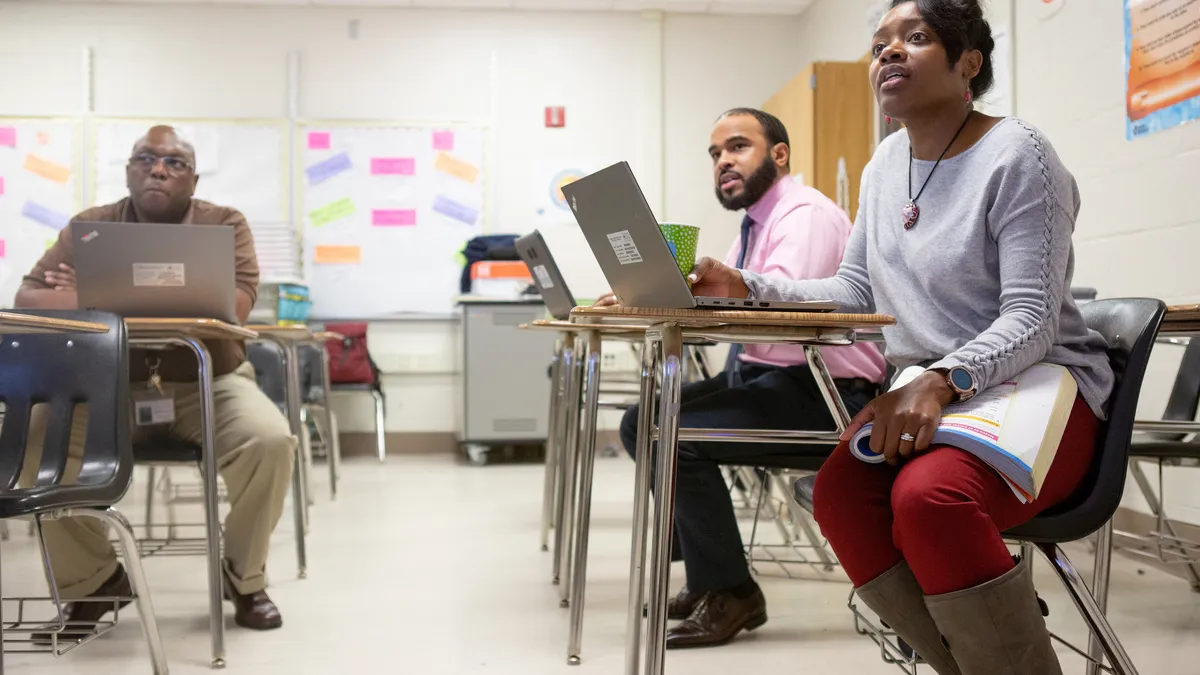
Teachers need professional development on artificial intelligence tools if they want to safely and effectively use the technology in their classrooms, legislators and witnesses agreed in a House subcommittee hearing Tuesday.
Doing so, however, requires federal supports, witnesses said during the hearing held by the House Subcommittee on Early Childhood, Elementary, and Secondary Education.
While some Republican and Democratic lawmakers expressed interest in providing federal resources toward professional development in effectively using AI in lessons, Democrats said that is harder to do since the Office of Educational Technology was shuttered last year by the Trump administration’s mass layoffs at the U.S. Department of Education.
“Historically, the department has helped provide critical resources to assist states, schools and districts in navigating technological challenges,” said Ranking Member Suzanne Bonamici, D-Ore. “And what this administration has done to the department has diminished or even obliterated its capacity to provide these resources.”
Subcommittee Chairman Kevin Kiley, R-Calif., said professional development is extremely important as it pertains to mitigating the risks that come with AI in education. Those concerns, he said, can include the technology’s impact on students’ critical thinking skills as well as their data privacy.
“I think there's probably more of a role that we can play here in trying to expand access to high-quality, up-to-date professional development,” Kiley said.
The key challenge, he added, is that AI is moving at a “dizzying pace,” and that guidance from leading AI experts today could be outdated by next week.
Bonamici also pointed to a legislative framework on AI education and workforce readiness that she released in January. The framework includes providing evidence-based professional development resources to educators to better navigate the opportunities and risks of AI in classrooms, Bonamici said. “I hope we can work on this on a bipartisan basis.”
While teacher professional development on AI is scattered and varied among districts, students are continuing to embrace the technology in their classrooms. For instance, a little more than half of teens say they’ve used AI chatbots to help with schoolwork, according to a Pew Research Center poll released on Feb. 24.
During the hearing, Rep. Mark Harris, R-N.C., asked Teach for America CEO Aneesh Sohoni what teachers need most from their principals and superintendents. Sohoni responded that he’s heard from teachers who are worried they’re not getting enough professional development support to effectively work with the AI tools their students are already using.
House Education and Workforce Committee Chairman Tim Walberg, R-Mich., said during the hearing that AI can save teachers time, but training on these tools can sometimes cause stress. With that in mind, he asked Michele Blatt, state superintendent of schools in West Virginia, how AI training can equip teachers instead of becoming another task on their to-do list.
The West Virginia Department of Education has a professional learning management system with resources and information for all teachers to access at any time, Blatt said. When it comes to AI tools, Blatt has noticed that teachers have taken to the new technology quickly when they participate in training.
“While the professional learning and the effective use of this technology is important, it's not taking the level of training that we've seen with other things that we've rolled out in the state,” Blatt said.
Federal guidance on AI in schools has also been lacking as states have had to step up and offer their own technology recommendations to school leaders, said David Slykhuis, dean of the Dewar College of Education and Human Services at Valdosta State University in Georgia.
When it comes to who is defining the standards for AI in education, it’s a bit like the “wild, wild west” without federal guidance, Slykhuis said.
Rep. Summer Lee, D-Pa., asked Slykhuis why it’s important for there to be national guidance on AI use from the Education Department and what was once its Office of Educational Technology.
Such federal guidance is crucial, Slykhuis said, because private companies are moving to fill that void. While those companies can be well-intentioned, he said, they are still for-profit. To make money, these companies may also try to make their products addictive like social media, he said.
“Without some federal guidance and some top-level guidance to sort of prevent that kind of thing, it just enters into a very dangerous space, regardless of how well-intentioned people are,” Slykhuis said.