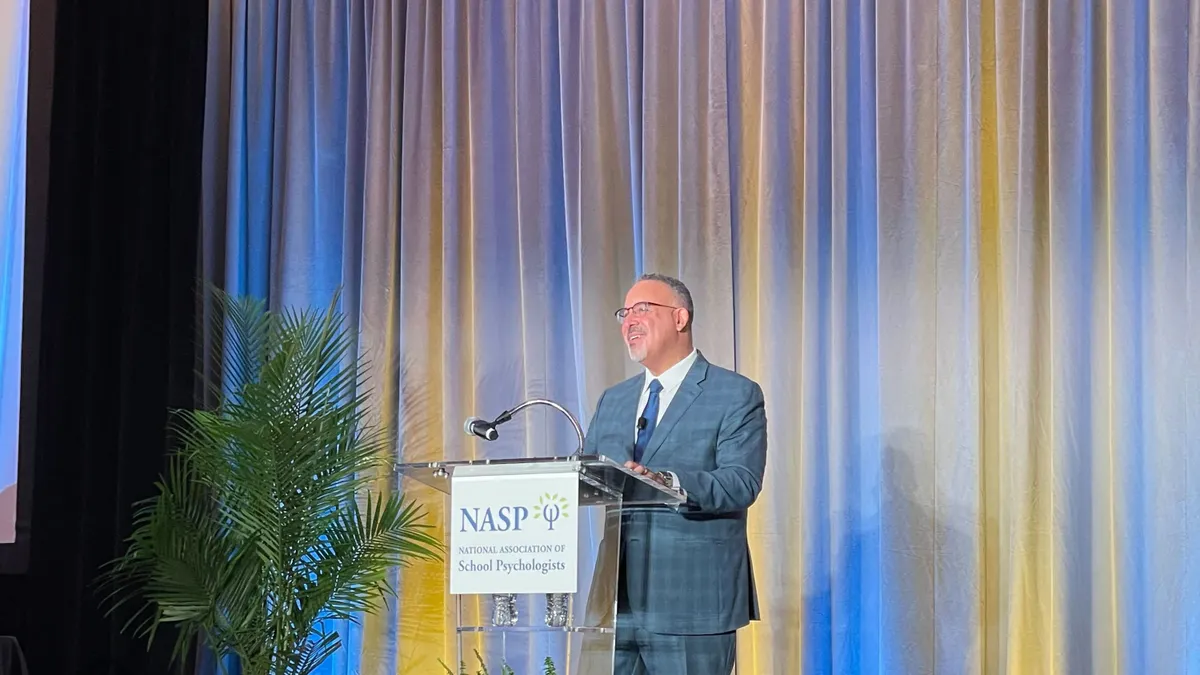
CHICAGO — “If not us, who? If not now, when?”
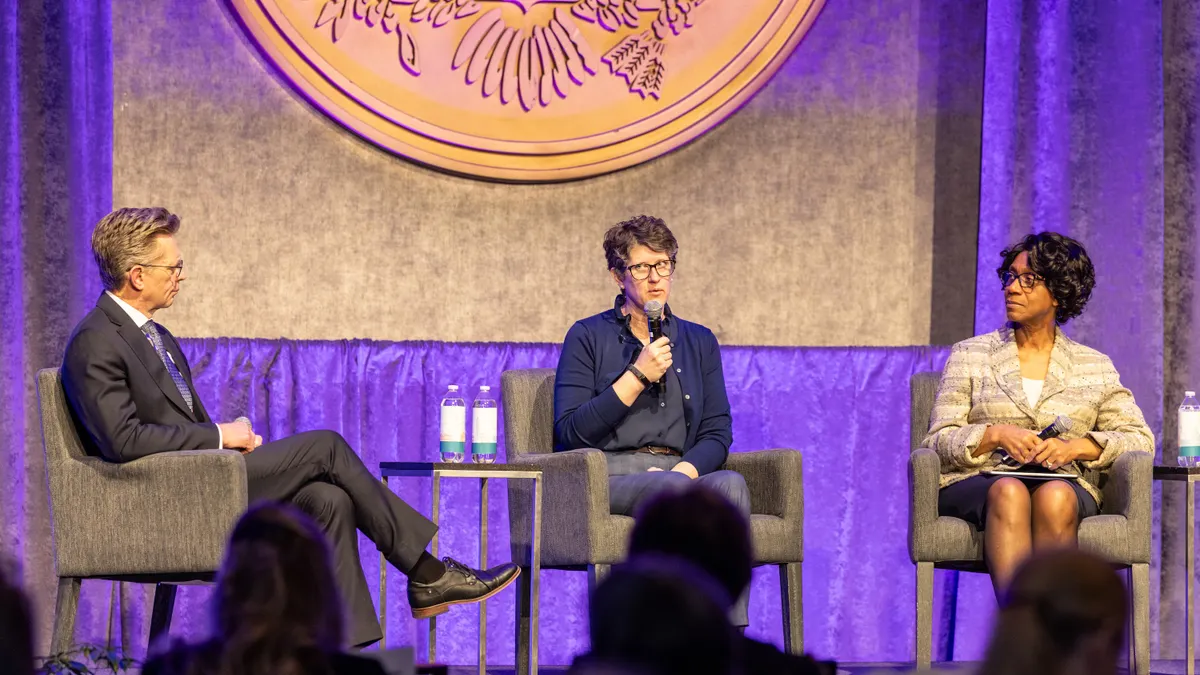
Citing the late Rep. John Lewis’ work on mental health issues, former U.S. education secretary Miguel Cardona asked this of a packed Hyatt Regency ballroom during his keynote address at the National Association of School Psychologists’ annual conference Wednesday morning.
The central message of his hour-long address: Student mental health cannot be a partisan issue, and the need for these services is urgent.
“We have an opportunity as leaders and mental health professionals to really reshape what it looks like to provide mental health supports,” Cardona, who now consults with school systems through Cardona Solutions, told K-12 Dive prior to the session.
“We've taken a big hit from the federal government, but it doesn't mean that we can't come out stronger," Cardona said. "It doesn't mean that we shouldn't be forming stronger alliances, and then reimagining what it could be.”
Over the course of our conversation, Cardona shared his thoughts on the impact of school mental health grant cancellations and reissuances under the Trump administration, the impact of artificial intelligence on student mental health, and more.
“I can bet against politicians. I could bet against bureaucrats. But I won't bet against our educators who are in our classrooms, in our schools, meeting the students where they are,” he said. “My money's on them.”
Editor’s note: The following interview has been edited for brevity and clarity.
K-12 DIVE: In terms of school-based mental health grant cancellations and reissuances, how much does that sort of political ping-pong disrupt or impact what schools are actually able to do for students on these fronts?
MIGUEL CARDONA: We prioritized mental health supports for students and families and educators. The $190 billion of the rescue plan that was aimed at schools had a requirement that mental health supports were a part of it.
As secretary, when I looked at plans and approved them or kicked them back, it was based on whether or not they had mental health supports.
The Bipartisan Safer Communities Act added another $2 billion for community schools and money for 16,000 more mental health professionals in our schools.
So it was a part of the fabric of our leadership to ensure that we were looking at the whole child and meeting their basic needs in order to support academic development, but also to address the trauma that our students were facing — before the pandemic and exacerbated by the pandemic.
The cuts with this current administration provide not only a yo-yo effect for our school districts — we have people being laid off who are needed to support our students. But more importantly, it provides a yo-yo effect to our students and families who are in desperate need of support.
In 2021, CDC [the Centers for Disease Control and Prevention] found that 1 in 3 high school girls seriously considered suicide. By pulling those supports away, we are basically neglecting our students and our families from getting the support that they need.
We know children are six times more likely to get mental health supports if they're embedded within the school day, and I can tell you as a former school principal that is true. So what's happening with this administration is one of the grossest forms of educational neglect that I've seen in my career as an educator.
For the school systems that have been impacted by the loss of funding from grants they thought they were going to get, are there avenues they can pursue to ease the blow from that and make sure they're able to get these sorts of services?
CARDONA: I think, first of all, we’ve got to remember this is not a red or blue thing. Providing mental health support is not a Democrat or Republican thing. It's a basic support for students in order for them to reach their God-given potential.
So more than just saying, “OK, where are grants” or “How can I get creative around grant funding,” we must strengthen our alliance around supporting the need for this — becoming active in terms of advocacy for dollars that are aimed at mental health supports for students being [seen as] just as important as dollars to help reading programs.
What good is a reading program if children are anxious or dealing with trauma from homelessness or other trauma in their life?
We have to continue to advocate to make sure people understand how important this is. That this isn't a Democrat thing, this is a child thing. It's a very basic level of advocacy that I'm asking for, and alliances need to strengthen and form.
At that point, the advocacy should lead to local, state, and federal funding advocacy and ensuring that it doesn't go down the partisan line. It seems that whenever there's a Republican administration, there's opposition from Democrats. And when there's a Democrat administration, there's opposition from Republicans — regardless of the merit, sometimes, of what is being discussed.
We’ve got to remove the politics from providing mental health supports for our students. I would argue that our red states need it even more so. Our rural students don't have the access to community-based mental health providers that our city students do in New York City, so the mental health supports that are provided in our schools in rural communities are the only game in town for a lot of our rural kids.
We have to lift that issue up and say, “This is good for kids. This is not about politics.”
“What good is a reading program if children are anxious or dealing with trauma from homelessness or other trauma in their life?”

Miguel Cardona
Former U.S. Secretary of Education
With the news this week that a new interagency agreement would push a lot of school safety programming oversight to the U.S. Department of Health and Human Services, what advice would you have for HHS as far as oversight of those programs goes — particularly when it comes to the sort of mental health supports that serve as proactive or preventative school safety measures.
CARDONA: I'm a big believer in interagency collaboration. When I was secretary, I worked with [then-Health and Human Services secretary] Xavier Becerra to make sure that we were improving Medicaid reimbursement, so I really believe in that as a premise.
What I see happening in Washington, D.C., though, doesn't mirror interdependency.
It means giving it to another agency that is woefully understaffed and maybe doesn't have a nuanced understanding of what school-based mental health supports looks like. Quite frankly, I think they're handing it over to the least-competent Kennedy [HHS Secretary Robert F. Kennedy Jr.], and I don't have confidence based on what I've seen from him with regard to other health factors that it's gonna be handled well.
On paper it sounds nice: “Let's have the Health and Human Services Department handle school-based mental health.” But if you look beyond the headline and see the actions, to me, it seems like it's going to go to a department that is understaffed and doesn't have a nuanced understanding of how important school-based mental health is.
With all of the talk about student loneliness and the development among young people of attachments to AI chatbots, what do you think schools should be aware of?
CARDONA: When the Internet came out, I was a 4th grade teacher, and we didn't have guardrails, and it was a mess. Students were exposed to things they shouldn't have seen.
Then 10 to 15 years ago with social media, there were no guardrails, and students were exposed to things that they should not have seen. And I think it contributed to isolation and the youth mental health crisis that we're in today.
We're at the third chapter, and we have artificial intelligence, and this has the potential to really help our students be competitive and grow. There's a lot of potential. But we also run the risk, if left unchecked, to have it harm students.
We have a responsibility as educators not to look the other way — or not to lock their phones up and think that it's going to go away — but to say, “I need to teach you how to self-regulate and develop good habits so that you could use this to be productive and grow.” Versus become addicted to it or fall in love with an AI companion, which is where many of our students are going right now.
We have a responsibility to step in front of it, and I'm prepared to lead in that space and welcome the opportunity to engage with districts and states who are serious about this.
On a similar note, are there any concerns that you have when it comes to schools that are using AI for mental health advice or support, or just the overall trend that students are also, on their own, seeking out AI for mental health advice and support?
CARDONA: They're doing it with or without us, so we need to be aware and get in that space, create guardrails, and make sure that our understanding of what appropriate mental health support looks like is influencing whatever behaviors they're doing.
To say that they're not going to do it if we don't introduce it in schools is foolish. We need to be involved, engaged, and maybe we — NASP, psychologists, educators, leaders — need to say, “These are the dangerous things that are happening, and these are the things that, if students are going on these platforms, these are some appropriate prompts or sites that we feel are positive for students” — versus those that are giving students information or recommendations that are not appropriate, or are dangerous.