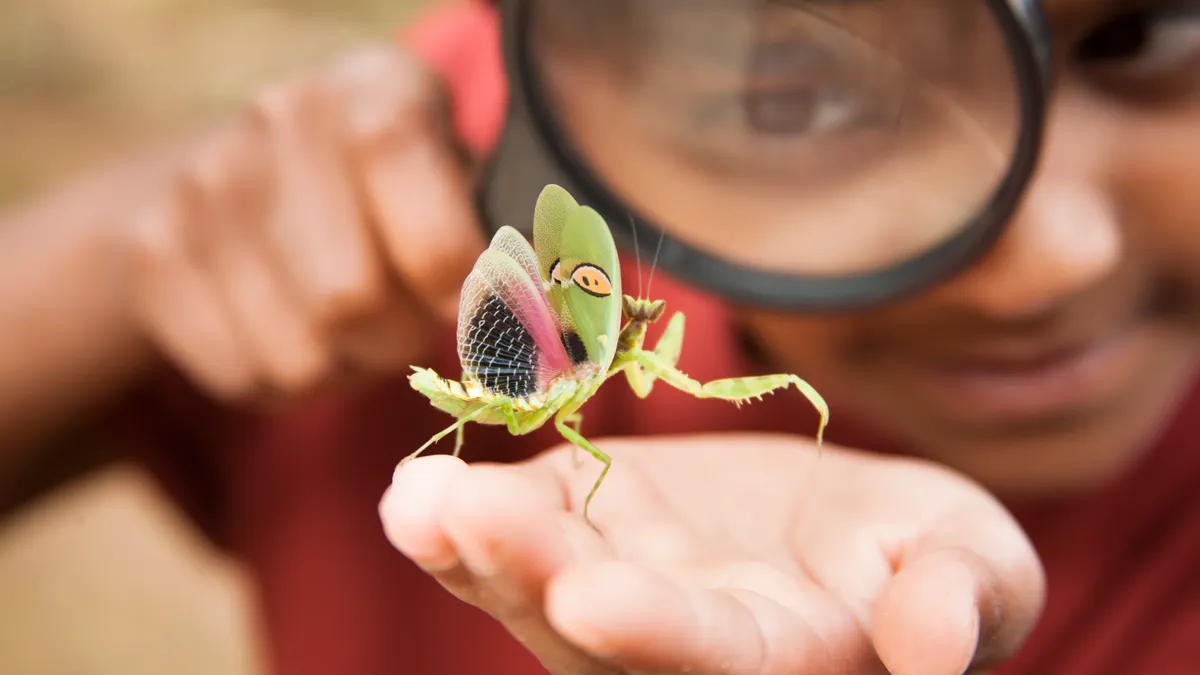
Lessons that introduce young learners to different types of bugs and insects can be one way to stimulate their interest in science and get them in contact with nature, provided teachers tamp down any “ickiness” factor students — or they themselves — might feel.
“On the playground, we’ve found worms, and we pick them up,” said Michelle Durange, kindergarten teacher at Alloway Creek Elementary School in Littlestown, Pennsylvania. “We try not to be scared of it, so they’re not scared of it.”
When Durange looped into 1st and 2nd grade, she said, “We used to get these creepy bugs, and let [students] see them, touch them, feel them.”
As professor emeritus of science education in the School of Teaching and Learning at Illinois State University, Tony Lorsbach has found that many teachers don’t want to teach about insects and bugs because they don’t like them.
“It’s sort of a cycle. Who do you teach first, the teachers or the children?” he said. “It’s probably best to do both. I taught future elementary school teachers for 34 years. When we came to the topic of insects, it was, ‘No, I’m not going to touch them.’ And I’m like, ‘You could have a budding entomologist in your kindergarten class.’”
Durange often starts such science lessons with literature, citing books like “The Ant Bully,” about a boy who finds an ant and wants to kill it. He squirts water on the ant, but rather than drowning, it gets larger.
“We have a lot of books we read. We do caterpillars to butterflies,” she said. “We have a [classroom] science center. … Basically in kindergarten, it is about exploring.”
Students observe animals in containers and put them under a microscope, although they don’t typically do a lot of touching at the kindergarten level, Durange said. And they talk a lot about the fear of bees, which most younger children are afflicted with, and why bees are important to the ecosystem, she said, adding that her father-in-law was a beekeeper.
“My father-in-law always clapped his hand, trying to get a bee away from him,” Durange said. “You’re huge. That little tiny bee is so small. The only reason he’s going to hurt you is if you are scaring him. So stay away from him.”
And of her students? “For the most part, they’re better about the bees. Most of them will leave them alone.”
Children often don’t like being outside among spiders and other arachnids, bugs and insects, but teachers need to place them in the context of the overall environment, Lorsbach said.
“They’ve got to get to know them,” he said. “They need to have experiences with them.”
Lorsbach suggests starting by putting a preserved specimen under a microscope and making observations. “To teach children to care about the environment, we need to teach them about the environment,” he added.
That doesn’t require going to a forest preserve, necessarily, and not every school has one nearby, Lorsbach said.
“Your school playground is good enough,” he said. “They can turn over rocks and start looking for roly-polys. There’s usually a kid who doesn’t mind picking up a roly-poly. The teacher needs to pick one up. You have to try to withhold your phobia from your students. Don’t be frightened of all these things.”
If, for instance, a wasp gets into a teacher’s classroom, he advises not to freak out. “Odds are, it’s not going to hurt you unless you do something silly with it,” Lorsbach said. “That fear factor with students comes from somewhere: It comes from the adults in their lives.”
Early childhood learners enjoy scavenger hunts, so Lorsbach also suggests creating laminated cards with pictures of bugs and insects students will be able to easily find in the schoolyard — which requires prep work on the teacher’s part to figure out — and then set the students loose.
“It’s just giving them hands-on experiences with insects that you know are not going to hurt them,” he said, adding that he’s seen research that the average American spends 23 hours per day indoors. “We just don’t spend enough time outside. With early childhood learners, you have that ability.”