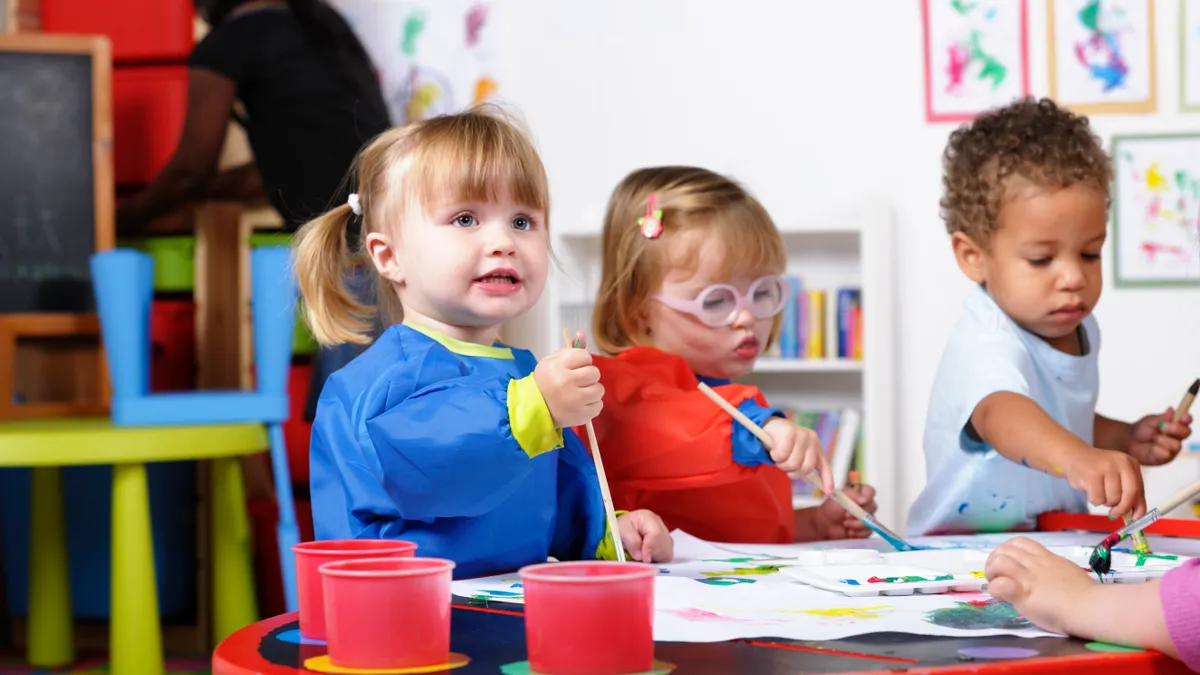
Sensory play using items like water tables, sandboxes and woodworking sets with age-appropriate tools can help preschool-aged and older children regulate their emotions, learn vocabulary and even support brain development.
“The research shows that sensory play is so important, for multiple reasons,” said Erin O’Connor, director of New York University Steinhardt’s Early Childhood Education program. “One of which is, when the brain is still wiring and rewiring in those early years, sensory play helps to build the brain’s infrastructure. It supports making connections across various [sensory] areas.”
For example, she said, a child playing with dough feels what it’s like to knead that dough, can smell the dough, and is likely to be talking about what they’re doing with it.
“You’re involving various senses there, and you’re encouraging those synapses to fire together, leading to the myelination of the neurons,” said O’Connor. “It’s also helping children do things like natural cause-and-effect that you can’t do on the screen, if you’re actually doing it yourself.”
Sensory experiences also provide younger children the opportunity to verbalize their thoughts and feelings using more complex language than they typically would if they were simply reporting back something they saw on a screen, O’Connor said.
“It was goopy, it felt sticky — all these adjectives that you’re encouraging children to use that they might not in other areas of the school day,” she said.
In addition, sensory play helps students learn to focus more clearly and dependably in a setting where they’re getting multiple different inputs — a skill they will need as they get older, O’Connor said.
“If you’re focused on the feeling of the slime, you might not be as focused on other things around you,” she said. “You focus on that information and stick with it.”
O’Connor suggests that sensory play definitely should continue into kindergarten, with its higher classroom child-to-teacher ratios, more hectic environment than preschool, and at least somewhat greater academic demands and stresses. That’s partly because sensory play helps to calm the body, with studies tracking reductions in cortisol levels.
“It can help in terms of that transition to kindergarten, with the expectations and stress,” she said. “Sensory play can help reset you.”
Sensory play can provide a bridge to more traditional academic material, such as introducing concepts like numbers and letters, which are a bit more abstract than children of that age might be used to, O’Connor said.
“You can use sensory play to make it more concrete,” she said. “If you write the letter ‘A’ in shaving cream, that’s more tactile than if you write it with a pencil. Kids are also developing their fine and gross motor skills during the kindergarten years.”
As they age through elementary school and beyond, to the extent students engage in anything sensory, it’s often geared toward building greater focus and attention, O’Connor said.
“It’s things like sitting on a yoga ball or being allowed to have a stress ball in school,” she said. “That helps in terms of regulating the system and calming them down so they can focus more on what’s actually going on in the classroom, rather than these various feelings and thoughts you’re having.”
Ultimately, how to encourage sensory play in a preschool classroom can be very open-ended, O’Connor said.
“There’s no wrong way, generally, to engage in sensory play,” she said. “That also encourages kids to be more open-ended in their thinking: ‘This could be this; it could be that.’ Which encourages cognitive flexibility, which is definitely something that correlates with academic and social development later on.”