Dive Brief:
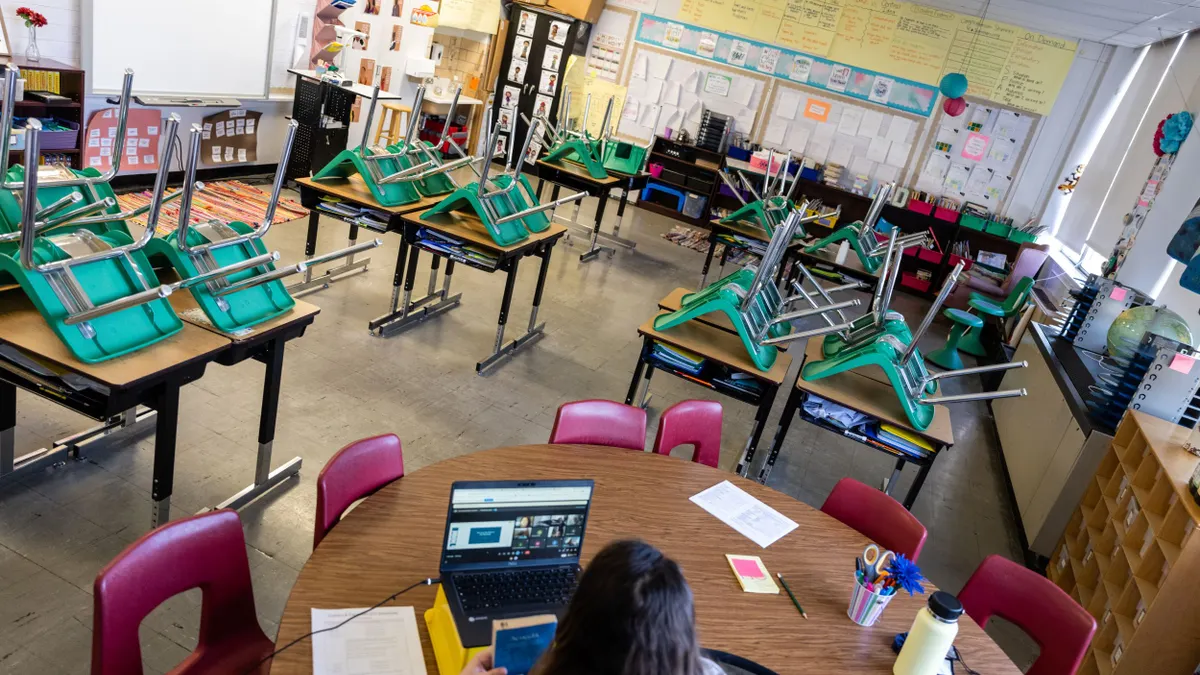
- School reopenings following pandemic-era building closures decreased rates of depression, anxiety and ADHD in students, according to data drawn from 24 California counties between March 2020 and June 2021.
- The study, published in late November in the journal Epidemiology, found returns to classrooms were linked to a 43% decrease in monthly mental health diagnoses and a nearly 11% decrease in related non-drug healthcare expenses. These impacts were seen nine months after school reopenings, though benefits typically occurred after six months of reopening.
- The largest differences were seen in the improved rates of anxiety and depression, with positive impacts more pronounced among girls, the study of 185,735 children found. The study’s authors noted that the sample overrepresents students from high-income areas.
Dive Insight:
The study, conducted by researchers at Harvard University's T.H. Chan School of Public Health,confirms pandemic-era concerns that decisions to close or reopen schools came with impacts to students' mental and physical well-being.
"In-person learning is an important component of children’s mental health," the study’s authors wrote. "These results are informative for future policymaking during public health crises, to balance infection risk with the need for socialization and other critical resources that schools provide to children.”
Pelin Ozluk, the study’s lead author said, "For school and district leaders, the major takeaway is that the physical and social environment of the school building is not replaceable by remote learning."
Ozluk added, "The social connection, adult monitoring, predictable routines, and access to supportive staff that schools provide appear to be protective in ways that were difficult to replicate during closures."
School closings could affect children in a number of ways, researchers wrote, including through changes in social interaction, irregular sleeping patterns, increased screen time, less balanced diets, learning challenges and decreased educational performance.
Other factors such as families' socioeconomic challenges or tensions at home could have also played a role, they wrote.
"This study provides rigorous evidence on the effects of school opening policies on student mental health, highlighting that schools are about much more than content delivery—the social context matters," said Rista Plate, assistant director of research and learning at the Collaborative for Academic, Social and Emotional Learning, in an email to K-12 Dive. "Finally, it reinforces what we know: students need intentional support to mitigate pandemic-related challenges–academic and nonacademic."
Almost one in five students attending public schools in the U.S. tap into school-based mental health resources, according to another study published by nonprofit KFF in 2022 and updated in September.
Schools offer resources such as case management, one-on-one counseling or therapy, and referrals for care outside of the school. "Losing access to these resources may have contributed to the changes in children’s mental health observed in this study," the study’s authors wrote.
However, recent federal-level changes such as changes at the U.S. Department of Education, freezing of mental health grants, and Medicaid cuts may cause disruptions in such services, KFF warned — with some school mental health services in states such as New York, North Carolina and Texas already feeling the blowback.
The Education Department issued over $208 million in new mental health grants on Thursday after revoking nearly $1 billion in mental health and professional demonstration grants across schools and other entities earlier this year, according to a lawsuit from at least 16 states challenging the administration's decision.
Kelly Vaillancourt Strobach, director of policy and advocacy for the National Association of School Psychologists, told K-12 Dive this summer that the exact amount is hard to quantify considering the grants spanned past and future years, including unspent funds.
The discontinued mental health grants originated in fiscal years 2022, 2023 and 2024. The department was expected to distribute up to 59 awards to new recipients for both the School-Based Mental Health Services Grant and the Mental Health Service Professional Demonstration Grant, with awards averaging up to $1.5 million.