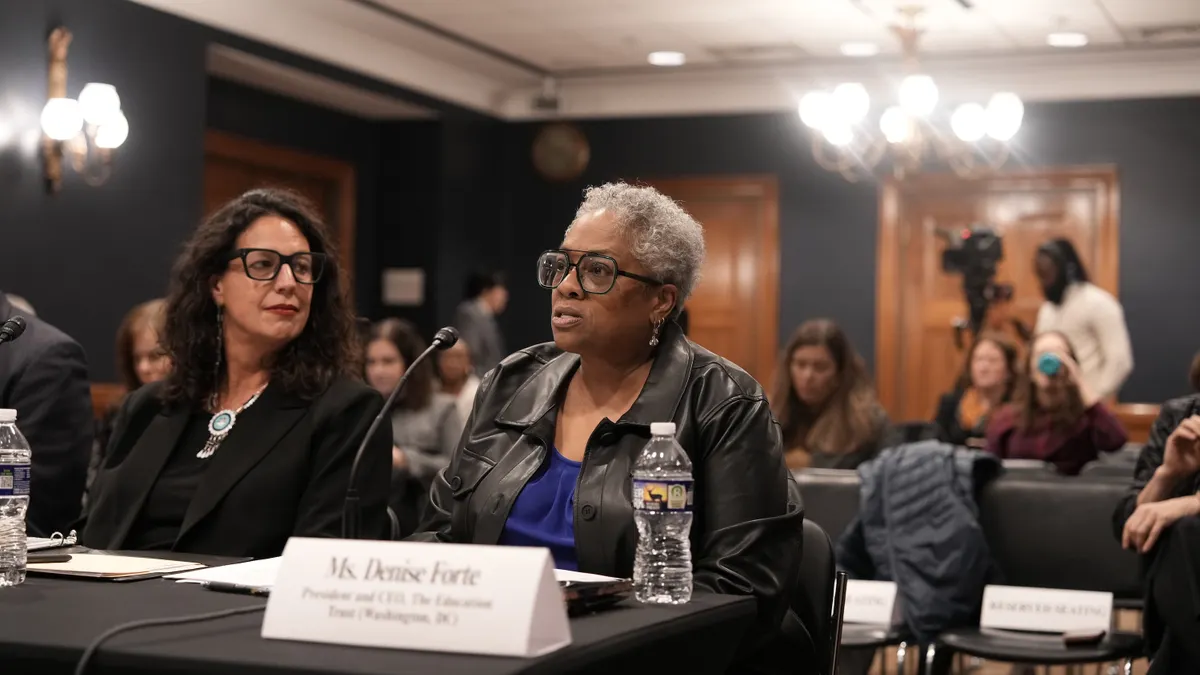
Denise Forte is president and CEO of EdTrust.
Tucked into the "One Big, Beautiful Bill" is a multi-billion dollar a year tax giveaway in the form of a federal voucher program. Given the current state of the U.S. Department of Education, a House budget proposal to slash Title I funds, and outcomes of state-run voucher programs, it is no surprise that early indications are that the Trump administration will stop governors who seek to craft programs that best fit the needs of their states and families.
Such a result would be a clear attempt to decimate public education in favor of private and religious schools.
Public schools serve 50 million K-12 students in the United States, and they serve every type of student: students of color, students from low-income and rural backgrounds, multilingual learners, and students with disabilities, among many others.
While public schools are far from perfect, they are the forming grounds for numeracy and literacy, career and higher education pathways, and civic and democratic engagement. Regardless of the outcome of regulations implementing the federal voucher program and the decisions of states to enroll or opt out of the program, state and federal policymakers must ensure the program does not become a workaround to end the pursuit for fair and full funding of public schools.
First, Congress must preserve and increase Title I funds
The federal voucher program is designed as a reverse Robin Hood scheme that will give away billions to wealthy Americans. Making matters worse, a current budget proposal from the House of Representatives would cut Title I funds by $5 billion.
Title I funds are much more targeted than universal vouchers, because the money flows to the students who need it most.
Title I is supporting classroom learning every day in schools across the country. Students in rural communities and high-poverty neighborhoods — where public schools fill what are otherwise often education deserts — depend on Title I funds that support the programs and initiatives that students depend upon for educational success.
We cannot expect vouchers to spread funding based on the needs of students. In Arizona, for example, only 4% of voucher recipients are from D or F-rated schools, which means students who need better educational opportunities and resources are not benefiting. Those same students are also being abandoned in public schools where per-pupil funding ranks 49th in the country.
Nor can we expect funding to be carefully managed. On any given day in Florida, recent reporting revealed the state’s education department did not know where 30,000 students were going to school and could not account for the $270 million in taxpayer funds it took to support them.
For context, $270 million, under the federal voucher plan, would equate to more than 150,000 taxpayer-funded tax write-offs.
And, in North Carolina, for the 2024-25 school year, 73% of voucher recipients were White – a 10-percentage-point increase from the year before. But roughly 45% of all public-school students are White. Put simply, the state’s voucher program is a move toward school resegregation and “separate but equal 2.0.”
Second, states must ensure that school funding formulas meet the varied needs of students
That means funding schools through a lens of fairness. Right now, public schools throughout the country are “plagued with persistent and longstanding funding inequities.”
Particularly, state funding formulas should support underrepresented student populations, including students of color, students from low-income backgrounds, multilingual learners, students with disabilities, and students from rural communities.
Michigan, for instance, uses the “Opportunity Index,” which bases school funding on concentrations of poverty.
Tennessee has adopted a student-based funding approach, which provides per-student funding supplemented with additional, targeted funds for students with unique learning needs. The state also funds student learning opportunities outside of the classroom.
And Alabama recently made a shift from a resource-based formula that funds staff and programs to a weighted funding formula focused on the needs of students. Schools will now begin to receive additional funding for students in poverty, students in special education and multilingual learners.
Third, Congress must protect funding and programs for accountability and transparency
Federal accountability requirements ensure that parents, communities, district leaders and policymakers know which schools and districts struggle to meet students’ needs and close stubborn racial and income achievement gaps. Most importantly, federal accountability requirements enable the targeting of additional resources and supports to students.
In March, the Trump administration gutted the office responsible for producing the Nation’s Report Card.
And in October, the Department of Education sought to eliminate data collection that helps ensure education is fair and accessible for all students, particularly for students of color and students with learning disabilities. The data are particularly important to protect the rights of Black and Latino students who are disproportionately targeted for discipline and identified as having learning disabilities.
We have also witnessed many states seeking federal waivers to evade federal education law and accountability provisions. These requests further seek to undermine guardrails meant to protect underserved student populations and weaken spending and student outcome transparency.
To make sure all students are served well, students and families need federal support for transparency and accountability.
Based on the recent actions of the federal government and states, we anticipate limited transparency and accountability under the federal voucher program. Private and religious schools already can avoid many federal education laws and accountability requirements, and they are able to discriminate against LGBTQ+ students or those of different religious backgrounds, limit enrollment, and offer few, if any, special education supports.
Current voucher programs show us that the federal initiative is not designed for all students. And numerous studies have shown that vouchers do not improve student achievement and have even led to students performing worse than public school peers in some states.
Every student has the right to receive an exceptional education from their public schools. And whether or not the final rules for the federal voucher program add or take funds away from public schools, it’s time to invest more — not less — in our public education system.




 Dive Awards