Pierre Orbe didn’t intend to become an educator.
Inspired by the experiences of his older brother, who is on the autism spectrum, Orbe originally planned to become a medical doctor with a focus on neurobiology.
In 2001, however, he took a “detour” into education, teaching science at New York City’s public Fashion Industries High School and Talent Unlimited High School.
“I was studying to go to med school after I graduated with my degree in neurobiology, and my father had carried me as far as he could through college,” says Orbe. “And he said, you know, ‘It's time to get a job.’ They were looking for teachers in science and math for New York City Public Schools, and I found myself in the classroom.”
What he also found was an environment where he could put lessons from his learning and cognition courses into practice — and where he could fuel similar motivation to that which initially inspired him to pursue neurobiology. Focusing on how students learn and how to make content relevant to them are foundational, he says.
“If I asked you what would make something relevant, it might be more real-world and authentic, versus my brother needing something hands-on and tactile,” says Orbe.
In 2017, after roughly a decade as an assistant principal at Talent Unlimited High School on the city's Upper East Side, Orbe felt he had more to offer — and something to prove.
That February, he took a new role leading DeWitt Clinton High School — which was at the time deemed one of the worst in the city for both violence and academics.

Student voice matters
Located in the Bronx, the 1,200-student DeWitt Clinton High School serves a grade 9-12 student population that is 61% Latino, 26% Black and 89% economically disadvantaged. Originally opened in Manhattan as an all-boys school in 1897, the school moved to the Bronx in 1929 and eventually went co-ed in 1983. It boasts an impressive list of famous alumni, including actor and comedian Tracy Morgan, writer and activist James Baldwin, fashion designer Ralph Lauren, comic book writer Stan Lee, and Kiss guitarist Ace Frehley.
But prior to Orbe’s arrival, the school’s reputation had fallen far from its storied history.
“Growing up in New York, I knew Clinton as not necessarily a school that you would want your child to go to,” says Tanya Dale-Pineiro, a former parent at the school.
In 2012, the New York Daily News reported that the school had “the city’s most heavily armed student body” with 33 weapons seizures and 252 “violent or disruptive” incidents in the 2010 school year. When Orbe took the reins as principal in February 2017, he was the third principal that school year. DeWitt Clinton also faced — and avoided — the threat of state receivership in 2017, says Orbe.
“From its years of glory, there was a window where young people were not being successful, where graduation rates really sort of tanked,” says Marcel Deans, superintendent of Bronx North High Schools, the district within New York City Public Schools that includes DeWitt Clinton. “There was a level of dysfunction across the school to the point where, as a system, we decided that we needed new leadership, and we needed to undergo a full transformation.”
Deans, who sat on the leadership team that hired Orbe as principal, says what stood out immediately was Orbe’s “self-assured confidence” and a “really profound vision” for bringing about the kind of change the school needed.
One of Orbe’s first orders of business involved staffing — namely requiring staff to reapply for their jobs as part of former New York City Mayor Bill de Blasio’s school renewal program. That process culminated in July 2018, when 74 staffers — including 18 teachers — were let go, according to Norwood News.
“I helped him and supported him in restaffing the entire school,” says Deans. “He made some really important decisions around staffing that helped to move the school forward and gave him the platform to really employ his vision for the systems that would help transform outcomes for young people across Clinton for generations.”
These moves, Orbe says, were made to address “basic structural issues” that fueled academic and disciplinary dysfunction within the school.
“There were more students in the hallways than there were in the classrooms,” says Orbe. “Students had a right to vote with their feet to some extent for why they wouldn't want to go to the classrooms.”

Students, he says, would tell him that teachers never returned their graded assignments or gave them their grades.
“They were very angry at that point,” says Orbe. “They didn't really want to hear from me. I'm the third principal. They looked at me and they were like, ‘Who's this guy?’ And they said any of the most atrocious things you could imagine saying to any adult or person for that matter. But they were angry, and they had a right to be.”
Based on what he was hearing from students, he began calling teachers into meetings and asking them to bring their gradebooks so they could share how they came up with grades for students.
“Some of them didn't have gradebooks,” says Orbe. “And I had to take them up on impropriety charges under educational law, because they were just essentially just making up grades.” Then with teachers who did have grades in their books, he would calculate the final grade with them on the spot and get the right one — but it wasn't what they had put on the report card, he says.
Rafael Erazo is a social studies teacher at DeWitt Clinton who joined the school in 2008 as a special education teacher. Under the staffing reorganization that Orbe implemented, faculty had to reapply for their jobs, he says.
School culture, he says, noticeably improved after the staffing overhaul.
“Through just, again, being rigorous and really hammering down on curriculum, I started to see the change in the students,” says Erazo. “They felt much more empowered, and the engagement — I started seeing a shift instructionally for sure.”
When Dale-Pineiro’s son — a 2025 graduate of the school — began at DeWitt Clinton in March 2023, it was originally intended as a stopgap while he transferred between parochial schools. He ended up staying through graduation, however, because he was “over the moon about the school,” she says.
Orbe’s commitment to students extends beyond academics, she says. “My son was a football player at Clinton, and the entire team was just asking over and over again for a scoreboard that actually works and for turf that looks like actual turf, because it really was neglected for a very, very long time.”
By the next parent association meeting, she says, Orbe had already gotten the ball rolling with cost estimates, time frames and the ramifications of prioritizing those improvements.
“He’s a man of his word,” says Dale-Pineiro. “It’s not pie in the sky type of thinking. He’s going to do it. That really helped me feel comfortable having my son stay there.”
A future every student can envision
When Orbe started at DeWitt Clinton, just 46% of students were graduating, he says. According to the New York State Department of Education, the school’s graduation rate has since doubled — to 93% as of August 2024 — outpacing the state’s 86% average.
That improvement, according to those K-12 Dive spoke with, is a testament to Orbe’s ability to listen to students. Though just over 60% of the school’s graduates go on to enroll in college, according to data from the 2022-23 school year, there’s also a recognition by school officials that college isn’t right for everyone and that students also need other relevant and robust postsecondary options.
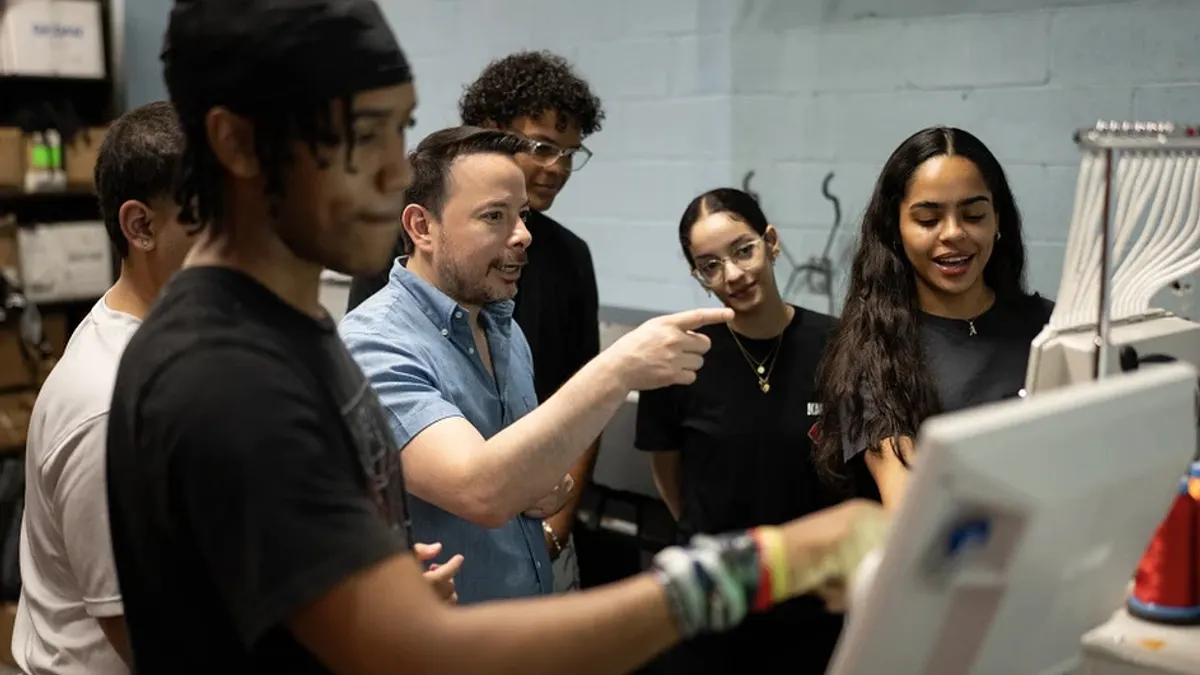
The school now has an array of programming that includes career and technical education standards like HVAC and electrical careers. Other offerings include a real estate club that helps students graduate with a license, a course to earn a barbering license, and even a certification program for tattoo artistry.
DeWitt Clinton runs an internship program where students can work in-house in, for example, apparel design or fulfillment for the school’s general operations store, Orbe says. The school works with local businesses ranging from auto repair shops to pharmacies, as well as to arrange external internships for students.
“We go out and we hit the pavement,” says Orbe. “And we're asking people, ‘Hey, if we have students who we're paying for and we have liability insurance, would you be, as a pharmacy owner, willing to have several students come in and work shifts here? You don't have to pay them anything. They would just learn the skills that would benefit your business. And if you like them, down the road, maybe you would absorb them. If not, that's OK, too.’”
Erazo says the pathways have given a sense of ownership to students who may have otherwise felt voiceless, resulting in the kind of engagement that has fueled the school’s academic and disciplinary improvement. “It’s genius to me.”
An updated cellphone policy, for example, has led to fewer in-school fights, Orbe told K-12 Dive earlier this year. Under the policy, devices are collected at the start of the school day and delivered to students during their last class.
The school’s transformation has been recognized in both the city and nationally, with Orbe recently being named the 2025 New York State Principal of the Year by the School Administrators Association of New York State and 2025 National Principal of the Year by the Association of Latino Administrators and Superintendents.
“He’s really turned the school around from where it wasn't a great place for learning,” says Andrine Wilson, senior director of strategy and innovation for Bronx North High Schools. “It's really literally night and day from where it was then to where it is now.”
Visuals Editor Shaun Lucas contributed to this story.
 Read more