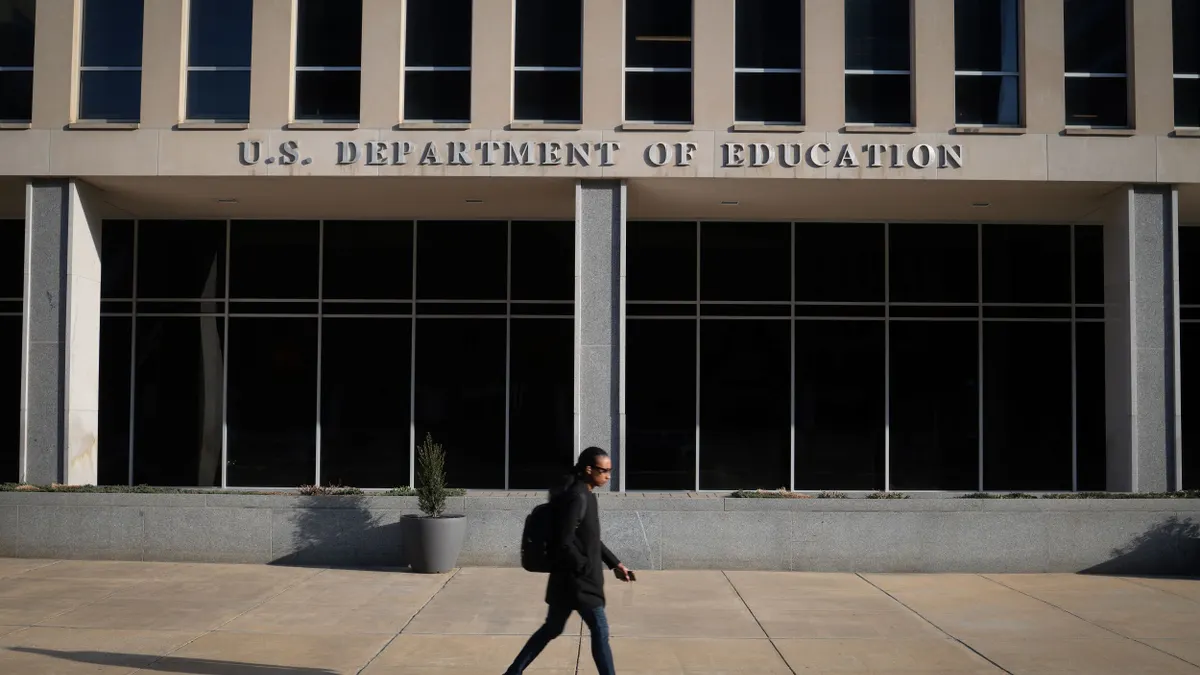
The U.S. Department of Education is pushing forward with innovations in the Nation's Report Card, despite layoffs that ripped through the National Center for Education Statistics, which administers the assessment, earlier this year.
The National Assessment of Educational Progress, or NAEP, will be administered online and primarily on school devices going forward — as opposed to department-provided devices — after the department field tested that approach this year, according to a Federal Register notice posted Thursday.
The notice also announced a bridge study in 2026 to compare scores from assessments using NAEP devices versus school devices. In addition, the agency announced a grade 8 science assessment pilot in 2027 for around 12,000 students attending about 308 public and private schools nationwide.
"NCES continues to pursue cutting-edge innovations to maintain the Nation’s Scorecard as the gold standard assessment," an Education Department spokesperson said in a Dec. 18 email to K-12 Dive. "Next year, the 2026 NAEP administration will be delivered via both school devices and NAEP provided devices — which will streamline the assessment for students, teachers, and administrators."
This puts NAEP roughly on the same track for online administration as prior to the layoffs. By 2026, NAEP was expected to be device agnostic and the Education Department had said after a spring 2023 field test that it expected to pull a portion of its field staff.
However, remote administration — meaning offsite and device agnostic — remains elusive. While it was expected to be possible some time after 2026, a department spokesperson on Dec. 18 did not provide a more specific timeline for its launch.
NAEP's planned innovations began under the leadership of Peggy Carr, the former long-time employee and commissioner of NCES fired by the Trump administration in February. The innovations were fast-tracked by the onset of COVID-19, which Carr said at the time provided "sobering lessons" when NAEP couldn't be administered as planned in 2021 due to pandemic constraints.
The department's latest update on NAEP's innovation timeline comes after U.S. Education Secretary Linda McMahon gutted the NCES office, leaving behind only a handful of employees to oversee the assessment and analyze the results.
However, McMahon said in April, one month after the first round of layoffs that impacted NCES, that NAEP will continue as planned in 2026.
“The Department will ensure that NAEP continues to provide invaluable data on learning across the U.S,” said McMahon in a statement then. However, former NCES employees have expressed concerns that even if the Nation's Report Card and other congressionally mandated assessments are administered on time, the lack of staff to oversee contractors and analyze data brings into question the data quality for future assessments.
"That would be my concern: that NCES does not have the expertise to ensure the quality implementation of the project," Carr, who is doing consulting work for now, told K-12 Dive on Friday.
NCES staff would usually have handled issues such as regular and real-time troubleshooting with equipment, coordinating with superintendents and other district staff, and addressing any mistakes and challenges on the ground at schools during the administration of the assessments. The federal staffers would also oversee the scoring of the assessment and monitor that daily to ensure minimal errors.
With most of NCES staff gone under the Trump administration's push to "end bureaucratic bloat" in the federal government and downsize the Education Department, this means school districts may have less help during assessment time, said Carr.
"It is all hands on deck during that six-week period," Carr added.