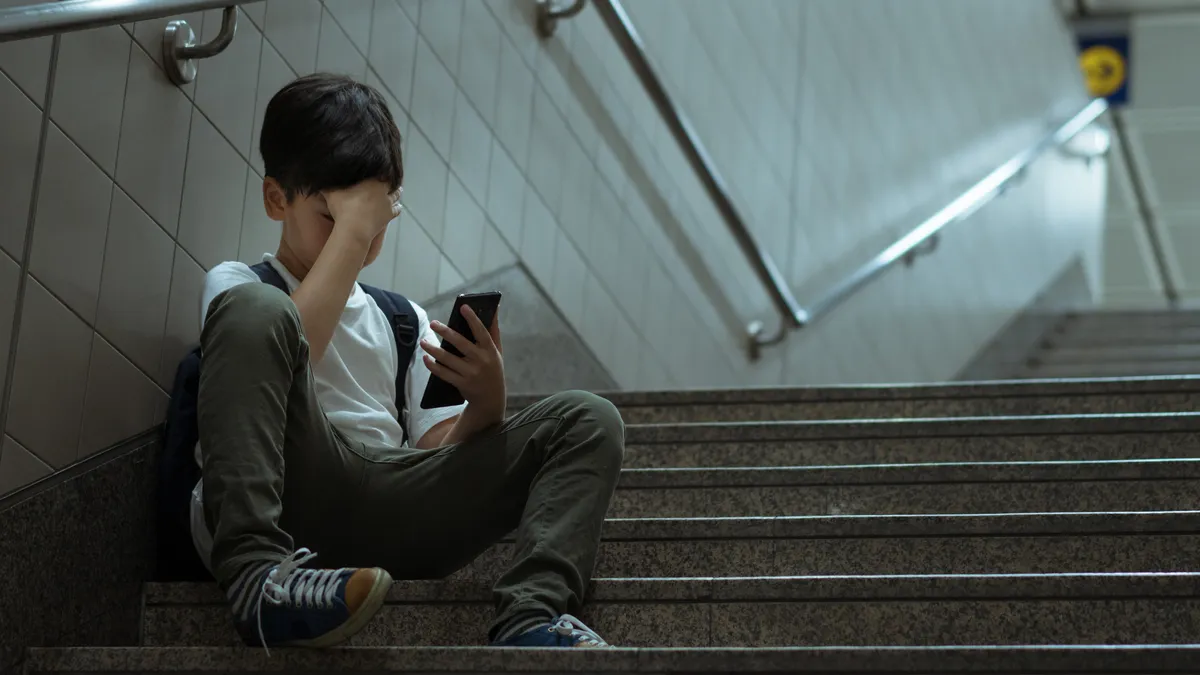
Increasing rates of loneliness and isolation have become a growing concern for researchers and policymakers in recent years, with some calling attention to the role schools can play in equipping students with the skills to overcome what has been described as an epidemic.
In September, for instance, California launched a Men’s Service Challenge aimed at finding 10,000 men to serve as mentors, coaches and tutors for young men and boys. The effort — which comes in response to evidence that these issues have had an outsized impact on boys and men — followed an executive order from Gov. Gavin Newsom that cited an increase among boys in suicide rates and disconnection, as well as decreased college attendance.
For schools, Newsom’s executive order called for increased efforts to recruit men as teachers and counselors, as well as a review of research into the impact of red shirting boys at the start of kindergarten.
Findings from the American Institute for Boys and Men published in August show that men and women reported similar rates of loneliness, emotional support and close friendships — although men were more likely to report not feeling like they belong to a particular group or community.
“Loneliness in general is a problem,” said Milena Batanova, director of research and evaluation at Making Caring Common, a Harvard Graduate School of Education initiative focused on moral and social development in young people.
She added that the problem underscores the importance for schools and districts to sustain strong social-emotional learning programs, which evidence shows improve social skills and sense of belonging while reducing loneliness and social isolation.
People are spending more time alone and have fewer friends and groups they’re attached to, Batanova said.
Making Caring Common conducted a national survey last fall in partnership with YouGov, which found that millennials and lower-income families reported higher levels of loneliness. The report, however, showed no significant differences based on gender.
“I don’t know if there are any systematic gender differences in studies of SEL,” Batanova said. “We of course know that boys internalize how they feel, as opposed to girls. Boys might need more targeted screening, asking them more specific, relevant questions. They might withdraw and seem irritable. Girls are more open to saying, ‘I’m lonely.’”
She added that there "needs to be some education for adults, recognizing and identifying issues, and then obviously knowing how to communicate about them differently with boys vs. girls.”
High-quality, sustained mentoring and structured interest groups around sports or other hobbies through schools or third-party entities can also provide mentoring and help foster a sense of connection, Batanova said, adding that while she doesn’t like to generalize, physical group activities play well with boys.
“Adolescents can sniff out when programs are too contrived or forced,” she said. “Programs need to meet them where they’re at, and match with their interests and extracurricular needs.”
Unfortunately, the relative robustness of such offerings tends to depend heavily on how well-resourced a school and its surrounding community are, and gaps in resources are widening. “It’s kind of like the ‘Hunger Games’ out there,” Batanova said. “It depends on where you live and what kind of schools you go to.”
When SEL programs are under-resourced, for example, loneliness becomes a secondary or even tertiary focus, which is understandable prioritization under those circumstances, Batanova said. But “we want to be preventative,” she said. “It can also miss a lot of kids. Targeted inventions and programs are important.”
Schools should try to leverage community supports like local Boys & Girls Clubs to gain needed interventions for populations particularly at-risk, Batanova added. “That’s why schools, obviously, do need many resources. They do need funding for mental health support. They need to be able to provide those services … I very much worry that the [funding] gaps are widening between schools that are well-resourced vs. those that are not.”
Educators also need to keep in mind that there are different dimensions of loneliness, Batanova said. While adults might immediately think of students who don’t have enough friends or don’t know how to make friends, others might have a large number of friends but still feel like they’re lacking meaningful connections.
“That’s another example of being more targeted,” she said. “It’s important to get to the bottom of what’s going on so these kids can be properly intervened with, which is why those community supports are so important.”
University researchers are another type of partner that under-resourced schools and districts should consider, Batanova said.
“They’re always in need of testing out programs, trying different modules and components of interventions for improvement,” she said. “It could be a win-win with very low cost. That requires someone to coordinate and manage those relationships, and be creative in how they’re done.”