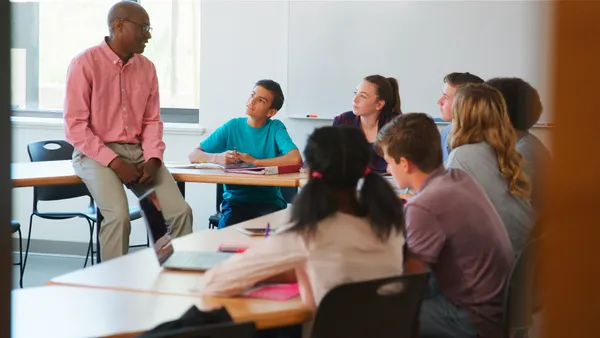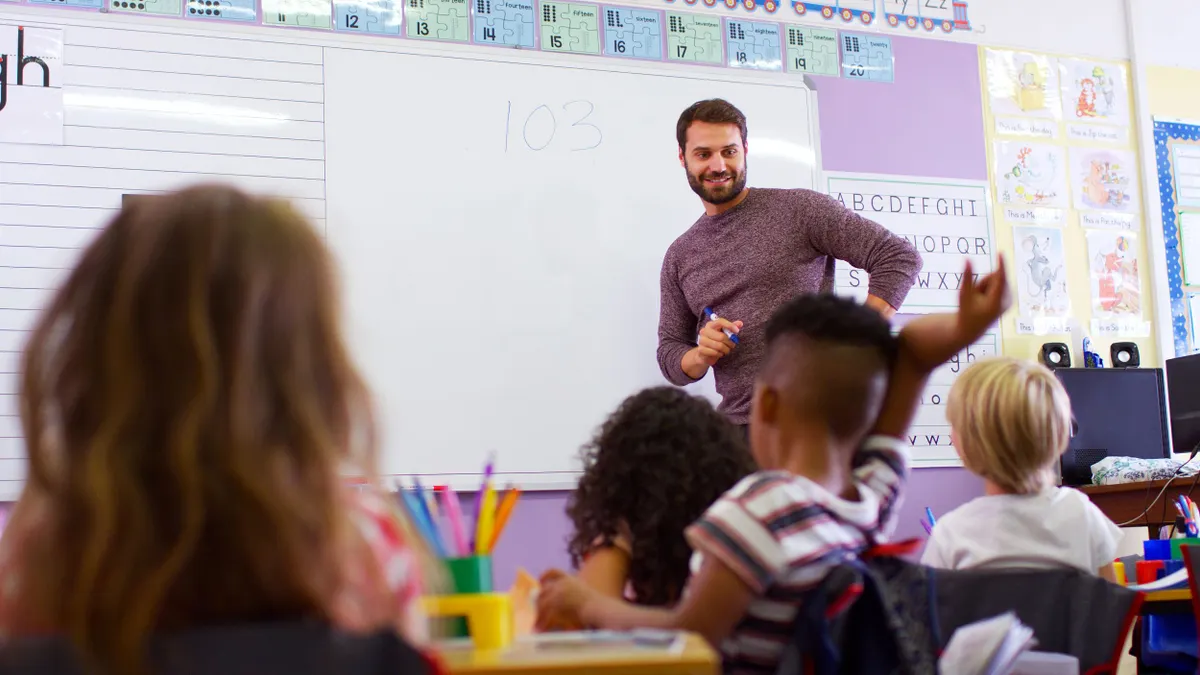
Scaffolding new lessons and concepts onto students’ prior knowledge builds a sturdier foundation for learning. Approaches can include charts and concept maps tracking what students know or want to know, helping them see links among ideas, and basing lessons on their own experiences, teacher educators say.
Before starting instruction on a subject-matter unit, teachers should analyze how students’ interests, passions and backgrounds could help to anchor their lessons, said Christopher Emdin, professor of science education at Columbia University Teachers College. “That becomes the pedagogical anchor point.”
Building on prior content knowledge helps to ensure that pedagogy is culturally responsive, said Natalia Ortiz, clinical assistant professor at New York University’s Steinhardt School of Culture, Education and Human Development. “One of the things we teach is the importance of making sure we are learning from our students about our students, to then help form our practice.”
Jon Star, professor of teaching and learning at the Harvard University Graduate School of Education, suggests that math educators encourage their students to brainstorm all of the problem-solving strategies that might be relevant to a math question, rather than jumping on the first concept that comes to mind and running with it.
“The teacher has to establish a culture in the class … that the teacher is interested in not only getting to the right answer, but in how they get to the right answer,” Star said. “They’re not going to engage in that reflection otherwise.”
And that reflection creates prior knowledge for students to access in the future, “essentially creating a database of features and strategy effectiveness,” he added. “It’s very meta-cognitive. … It’s taking those nuggets and storing them in my mind, increasing my knowledge of my knowledge.”
Ortiz, who is also director of the Office of School and Community Partnerships at NYU Steinhardt, suggests building out student knowledge “biographies” from subject to subject. This could include finding out, for purposes of a U.S. history or government class, what students already know, what they care about, and how they feel about different topics.
“This is boring. This is fun. This is why,” she said. “It’s an opportunity to connect with them to do brainstorming and ‘heart-storming.’”
Another way to scaffold students’ learning is posing a “do now” challenge in which students connect a lesson in history or science with their own lives, Ortiz said. When she taught about the Civil War, she would ask students to talk about a conflict they had at home.
If a student mentioned tussling with their sister over the television remote control, for example, “You’re fighting over resources,” she said, adding that it’s then the teacher’s job to connect that to what happened in the U.S.
Teachers should use “do now” exercises as a way to solicit responses based on prior knowledge, Emdin agreed.
“It’s the teacher’s job to pull from those responses and then connect them to the content,” he said. “When students tell their stories, that’s how they reveal their prior knowledge.”
Emdin also suggests anchoring instruction in students’ daily realities and creating a “co-generative dialogue” in which students feel free to critique the structure of a lesson.
“It begins with giving young people the agency to give feedback,” he said. “Once they feel like they’re the experts, they’re more likely to share what they knew previously.”
Another technique in lesson planning is drawing students into co-teaching a lesson, Emdin said. “In their planning, they are giving the teacher all this prior insight.”
“Passive learning comes when someone is speaking information to you,” he said. “Active learning develops when you are preparing a lesson.”
Blurring the lines between in-school and out-of-school — creating an assignment that makes connections between video games and physics concepts, for example, or bringing in rocks from a nearby park as an entry point to talking about weathering — can help make connections through metaphor, Emdin said.
“I tell teachers, ‘No more Google images,’” he said. “We live in an artifact-rich environment.”


 Dive Awards