Beatrice Viramontes is the executive director of Teach For America Bay Area in California, a nonprofit that prepares diverse, talented individuals to become teachers.
There’s no shortage of polling or think pieces trying to wrap our collective heads around the youngest group of American adults: Gen Z. While those efforts provide myriad valuable insights, one thing in particular sticks out — members of Gen Z bring to the table unique perspectives on working, careers and what they’re looking for in a job.

While conversations about the role of the American teacher have long been happening, the arrival of Gen Z to the workplace has forced the conversation to the forefront of priorities for those of us in education. That conversation overlaps with another long-running crisis in education: a shortage of teachers, especially in the most underserved public schools.
In a 2024 poll, Educators for Excellence found that only 16% of teachers said they would recommend the profession to others. On top of that, the percentage of teachers who said they planned to stay in the classroom for their entire career was 77%, down nine percentage points from 2022.
At Teach For America Bay Area, which I lead, we’ve created a collaborative alongside local partners to tackle a key question: How can we create the conditions to inspire young leaders to say yes to a career in teaching and sustain great teachers — of many generations — in the profession?
We are not the first to begin engaging with this important question. In fact, we’re learning from examples from across the country in the hopes that we can bring to our own community solutions that are working elsewhere.
In reimagining the role of the classroom teacher, we can connect with what Gen Z folks are looking for in a job, ignite their spark for education, improve staffing and teacher retention in our schools and, most importantly, best serve our students.
Here’s one way we can do this.
If you were to walk into most American public elementary school classrooms today, you’d likely see the following: one elementary school teacher, in front of her roster of maybe about 30 children. She’d likely be with that group of children all day — leading their lessons in math, reading, writing, science and social studies. She’d accompany them to lunch and recess, and perhaps would get a break when they went to music, art or PE for an hour.
Each day, she has to prepare, internalize and execute those lessons and adjust them to meet all of her students’ various needs — in math, reading, writing, science and social studies.
This is probably the elementary school model you grew up with. I know I did. But this “one teacher, one classroom” model, while surely effective for some, doesn’t mesh well with the interests of the next generation entering the workforce, or with the learning needs of all students.
There is limited agency and flexibility — in many cases, it’s pretty rigid. It’s linked with fewer people entering the education profession and more people leaving it.
It also hasn’t seen a “refresh” in decades. Additionally, it contributes to the burnout of teachers from many generations, not to mention the impact on students. Meanwhile, our world is rapidly evolving and changing. We need to rethink this model in order to accelerate outcomes for students and attract great talent into the teaching profession.
In 2019, the Next Education Workforce initiative at Arizona State University created a pilot team-based approach at a single school to try to tackle this workforce design challenge in traditional education. In 2022, they launched a learning cohort for schools interested in exploring new types of staffing models — working with 100 educator teams across 10 school systems in Arizona and California.
The Center on Reinventing Public Education has been examining the progress along the way.
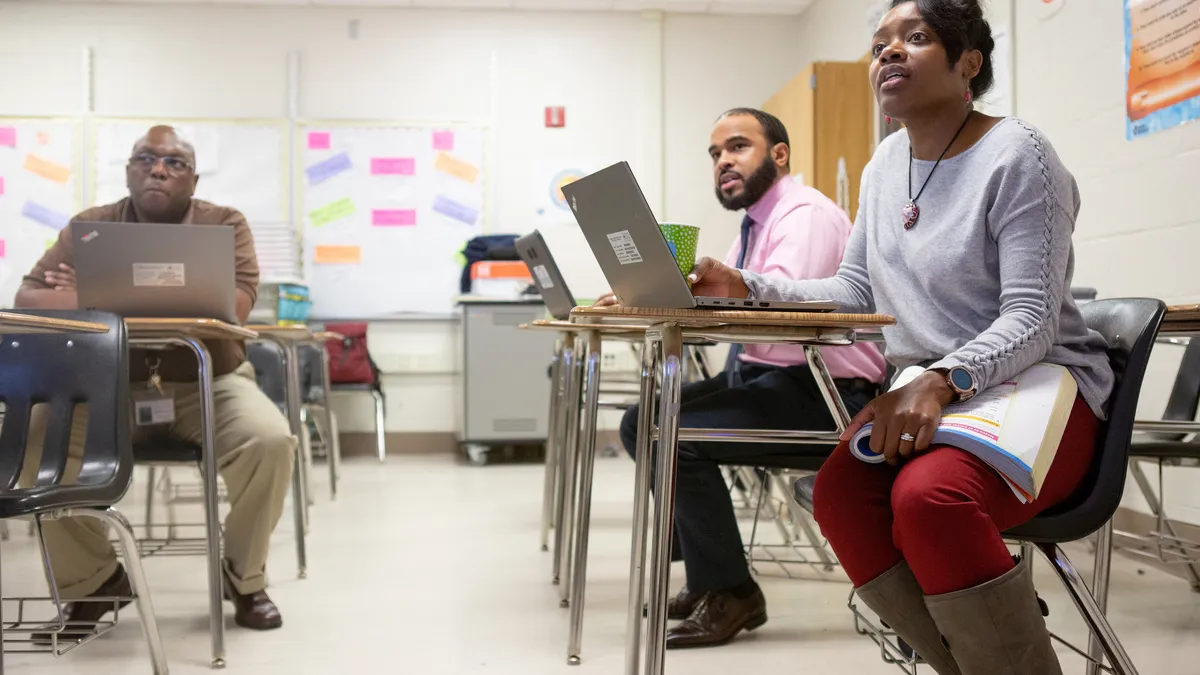
ASU NEW developed an innovative staffing strategy — allowing multiple teachers to work together across different subjects within a single school, rather than one teacher instructing one classroom of students. In this approach, four to five teachers are taking responsibility for about 100 students, depending on the grade level.
The teachers have differentiated roles and responsibilities, which can include specializing in a subject area. We think this can help address Gen Zers desire for personal identity development and purpose-driven careers. We also think this can reduce the complexity and workload for all teachers, which can help with retention.
For example, in kindergarten, one teacher may focus on phonics, changing the groups of students she’s working with all throughout the day rather than spending all day with the same 30 students. Meanwhile, another teacher may focus on math, also rotating student groups throughout the day.
That team of teachers collectively plans their teaching program, designing and implementing as they deem best meets the needs of their students and team. And those teachers, through specialization, can better internalize, prepare and teach their respective content. They can differentiate for students and create more tailored lessons to meet students at their level, providing the right interventions along the way.
This allows for specialization and collaboration and maximizes teachers’ strengths, better targeting student needs. It also creates a sense of collective responsibility and community — a helpful counterbalance to Gen Z’s reports of feeling disconnected in the workplace. This approach has shown some promising results: Teachers are more likely to report they have authority, and they’re less likely to depart their job.
Learnings from this are being brought to the Bay Area in a pilot program that’s under design right now. Five teacher teams across five different school sites are co-designing solutions that create different types of staffing models, to be launched this spring.
We’re embarking on this journey alongside local partners, including Thrive, a nonprofit supporting teachers and school teams, and Educators Thriving, a nonprofit helping to measure teacher well-being along the way.
In reimagining the role of the teacher, we draw inspiration from what Gen Z desires from the future of work, which we maintain will ultimately benefit all teachers and students. We’ll closely track the results of this pilot — an urgent task, given what we know about student achievement and teacher shortages.
But we believe, and we hope you will too, that now is the time to create the conditions to inspire more young leaders to pursue a career in teaching and keep some of our best teachers working with our students.