Dive Brief:
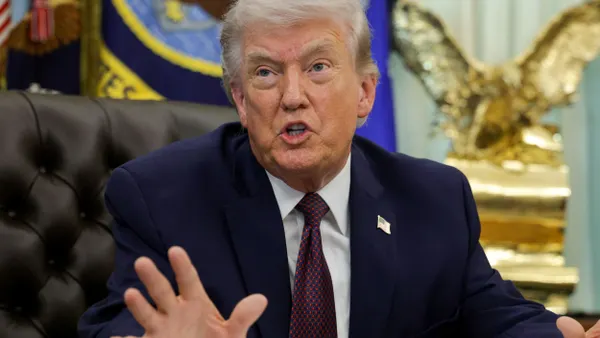
- President Donald Trump took another swing at longtime diversity, equity and inclusion initiatives in education, this time through his fiscal year 2027 budget request released Friday. The proposal would slash the Office for Civil Rights, which is tasked with protecting students from discrimination in education programs, by 35% from $140 million in FY 2025 to $91 million.
- The administration once more proposed slashing all $7 million for the U.S. Department of Education's Equity Assistance Centers, which were established as part of the nation's desegregation efforts and provide technical assistance and training to schools to address systemic inequalities.
- The budget plan also would end the $70 million Teacher Quality Partnership programs. Districts and colleges use the programs to strengthen teacher preparation and professional development and to improve teacher retention, particularly in high-need schools and subject areas.
Dive Insight:
The Trump administration has already unsuccessfully attempted to eliminate both programs during the president's second term, calling for zeroing them out in his fiscal year 2026 budget request.
Equity assistance centers are meant to help districts and school boards “address education issues occasioned by school desegregation,” such as harassment, bullying and prejudice, according to the Education Department’s website. The centers also help districts interpret data to identify disparities and to address those disparities through efforts like professional development for teachers.
The centers were originally established under the Title VI of the Civil Rights Act of 1964 and called Desegregation Assistance Centers.
"This program has been weaponized to force local districts to implement Washington-directed DEI practices against their will," according to a fact sheet accompanying the president's FY 2027 request. As "examples of weaponized grant programming," the White House listed equity audits for districts to assess racism and bias, training materials for educators on white supremacy, and "anti-racism committee" groups for districts.
Even before proposing zeroing out the centers in last year's budget request to Congress, the administration in February 2025 attempted to close all four centers nationwide, according to lawsuits challenging the move.
One of the lawsuits, filed by the Southern Education Foundation, led to the grant being temporarily reinstated for the center serving 11 Southern states. Program funds had been used there to provide online workshops to help schools tackle teacher shortages, lack of education resources, school-family engagement and other issues, according to the foundation.
Federal Judge Paul Friedman of the U.S. District Court for the District of Columbia, who reinstated the equity assistance centers grant in May, wrote that “the audacity of terminating its grants based on ‘DEI’ concerns is truly breathtaking.”
The Southern Education Foundation voluntarily asked the court to dismiss the case in October after the grant was reinstated, saying it reserved the right to file another lawsuit down the road if needed.
The Trump administration has also previously attempted to end the Teacher Quality Partnership program, which has often been used in efforts to diversify the teacher workforce. It was among the first grant programs that the Education Department slashed after Education Secretary Linda McMahon came into office with the goal of winding down the agency, calling the program "divisive."
The administration took that push all the way to the U.S. Supreme Court following lower court orders to reinstate the grants. The high court in April 2025 ruled for the administration and upheld a freeze on the grants.
The president's FY 2027 budget request, in attempting again to eliminate the entire $70 million program, said it is "used to indoctrinate new teachers" by teaching issues such as "social justice activism," "anti-racism" and "instruction on white privilege and white supremacy."
The president's budget request is the first step in the budget process. Congress will hold hearings and ultimately approve an appropriations bill for the president's signature. Regardless of that outcome, the president's budget blueprint shows the administration's priorities.