Dive Brief:
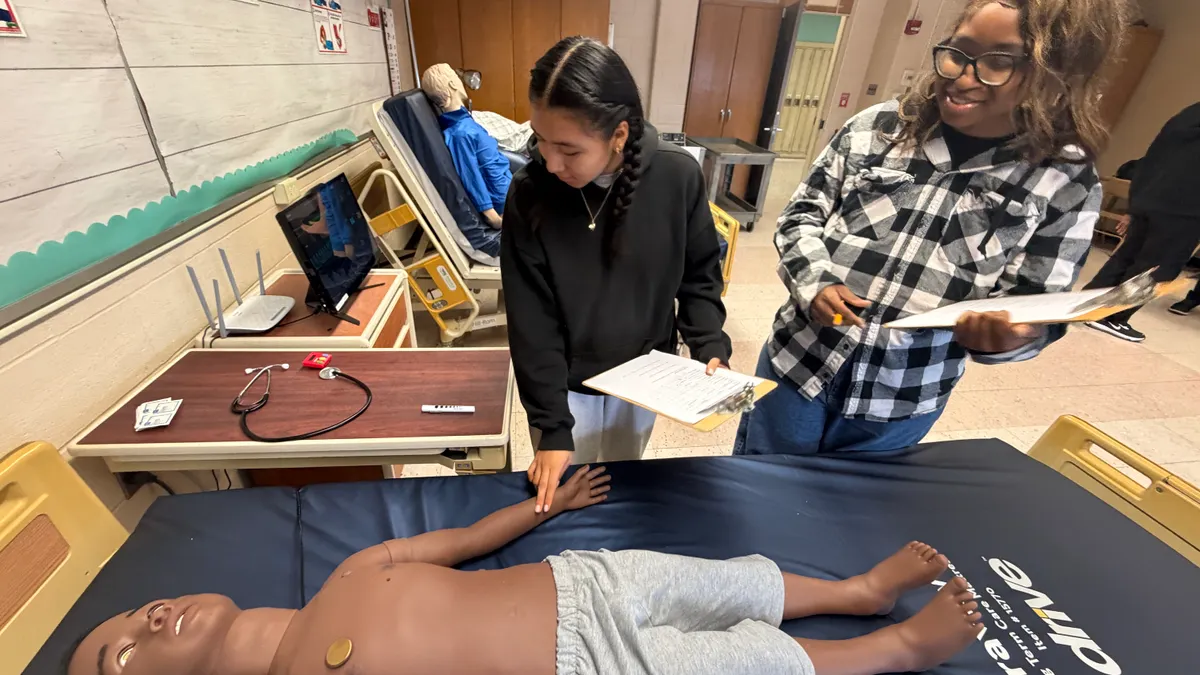
- Students at Baldwin High School’s Medical and Health Sciences Academy — one of seven career-focused academies in the New York school — have been gaining real-world experience thanks to artificial intelligence-powered medical “manikins” that mimic human movements and speech, as well as medical emergencies like heart attacks, seizures and respiratory failures.
- More typically found at the college level, if not medical or nursing school, these manikins are situated in classrooms designed like hospital rooms, with a bed and medical equipment. The manikins are given complete medical histories for students to analyze as simulations unfold, providing hands-on experiences that build critical thinking and teamwork, said Anthony Mignella, superintendent of Baldwin Union Free School District.
- “Our vision for instruction is centered on the future world of work, which is changing considerably due to advancements in technology,” he said. “It’s almost like a major: In addition to the core graduation requirements, they’re able to take electives that focus on a particular field that they may be interested in studying in college and pursuing as a career.”
Dive Insight:
The medical and health sciences academy starts with allied health in 9th grade, then EMT the second year, radiology and medical technology in the third, and finally college anatomy and physiology as a dual-enrollment course with Long Island University.
These experiences are all “designed to allow students to gain a deeper understanding of content through real-world applications,” Mignella said.
“Using the medical manikin powered with AI, we’re able to mimic human functions," he said. "It’s capable of blinking, breathing, and it allows students to treat it, and provide medication, and see if it works. The goal is to provide a college experience.”
The district community authorized a new technology fund to purchase the manikins and make the simulations possible, Mignella said.
EMT students are using them to take vital signs and administer CPR and first aid — in which they receive certificates at the end of the course. Radiology students can see lung function, for example, and the college anatomy and physiology courses have multiple other use cases for the manikins.
“The manikins can be programmed to speak and tell the physician-student what their ailment is,” Mignella said. “The computer screen will simulate the heartbeat and all of the biological functions taking place. The teacher can set the manikin up to emulate conditions like cardiac arrest or seizure, and the student has to apply their learning to diagnose and treat it.”
These immersive learning experiences jibe with Baldwin’s overall educational philosophy to build its curriculum around future-ready competencies like collaboration, creativity, critical thinking, communication, citizenship and character, Mignella said.
“They learn essential skills to function in an unpredictable future they may be walking into,” he said. “It's about content, but also about being able to utilize critical thinking and collaboration skills to solve problems.”
The school’s six other career academies focus on education; news, film and media; business and entrepreneurship; fine and performing arts; law and government; and STEAM.
Educators across all types of career and technical education programs are looking for ways to integrate artificial intelligence, and they’re looking to businesses and industries as a model, said Alisha Hyslop, chief policy, research and content officer at the Association for Career and Technical Education. In advanced manufacturing, for example, AI is used in quality control or for developing sequencing processes. In logistics, it’s used to design routes.
“However those tools are being used in industry is what CTE educators are being asked to do on the ground and integrate into their programs,” she said. “We see that across subject areas, probably a little more in high-tech areas than others, but not exclusively.” For example, she’s seen AI used in accounting courses to develop a business plan and audit budgets.
“There are probably very few programs it’s not being used at all,” Hyslop said. “The first wave of professional development for educators was about how they could use AI to improve or create efficiencies in their teaching."
Now what CTE educators are working to figure out is, "how they can focus on the AI that is industry-specific so students have those skills?” she said.