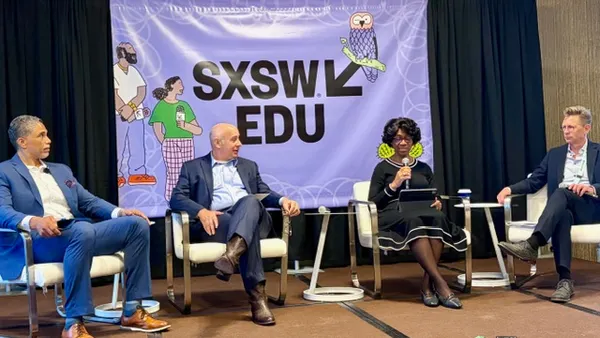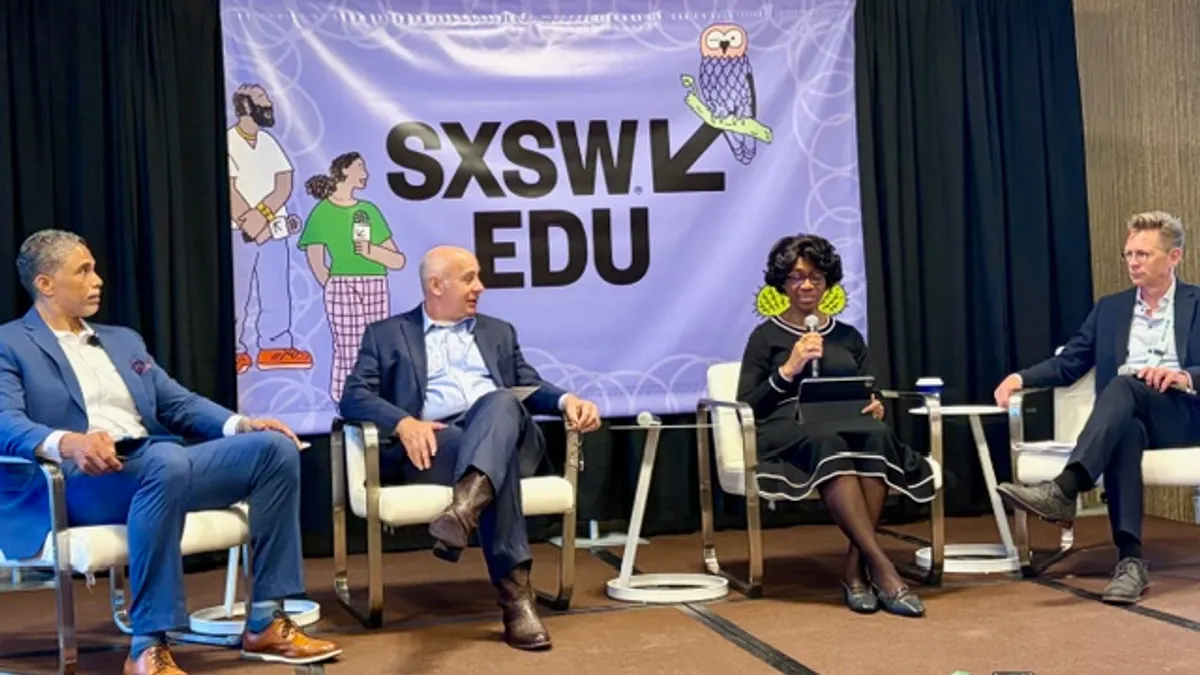
AUSTIN, Texas — Building trust and fostering alignment in K-12 decision-making among people with opposing political viewpoints is possible, but it requires a student-centric focus, persistence and inclusive coalition building, a bipartisan group of state education leaders said during a panel discussion at SXSW EDU on Tuesday.
As the midterm election season ramps up — with 36 governor races and thousands of state legislative contests ahead — and with the federal education landscape increasingly polarized, local and state education leaders are looking for ways to bridge divides and secure long-term buy-in for K-12 decisions, the panelists said.
"We had to find a way to build wide coalitions around the things that matter and the things that count the most," said Eric Mackey, who has been state superintendent of Republican-leaning Alabama since 2018. Mackey cited as examples in his state of bipartisanship work to advance legislation on literacy and numeracy.
"Just because somebody is elected as a Republican or they're elected as a Democrat does not mean that they embody all the same thoughts as everybody else in their caucus," Mackey said.
Keven Ellis, a Republican Texas state school board member and immediate past chair of the National Association of State Boards of Education, emphasized the importance of building relationships as leaders seek to find common ground to move initiatives along.
"Politics is a relationship business, and I think you have to make sure that you understand what makes people tick, and you have to realize that if you're not building relationships, you're losing relationships," said Ellis, who was first elected to the state school board in 2016 and more recently was appointed by Gov. Greg Abbott.
Coalition-building is critical, but it's also hard work and takes time, the panelists said.
"It's 24/7 that we are literally engaged in that work but so necessary and so important to be done." said Charlene Russell-Tucker, who was appointed commissioner of education in Democrat-leaning Connecticut by Gov. Ned Lamont in 2021. "It's still a challenge, believe me. It's never a day where you think you've got it all solved."
During the discussion, which was moderated by Education Commission of the States President José Muñoz, the panelists outlined four core approaches for finding agreement between the political aisles.
Have a student-centric focus
Russell-Tucker said it's important for educators to understand their "why" when engaging in their work. Her “why” is the 497,764 public school students in the state, she said. "I think it's really important to keep that at the center of what it is that we're talking about."
She said the focus has to be "keeping our students — not politics — at the center."
Additionally, Russell-Tucker said the adults making decisions on behalf of students need to model civic discourse. "I always challenge folks — my legislators and other interest holders — let's act as though the students are actually watching us," she said.
Invite all viewpoints
Several panelists said effective bipartisan work includes striving to bring people together, even if they have opposing viewpoints.
This includes inviting people with differing opinions to join task forces and to share their ideas and opinions, Mackey said.
"I think as you bring more people to the table, they begin to trust you and trust the process more," he said. "And so then when we do disagree — because ultimately we're going to have disagreements — then they don't think there's some nefarious undermining to the disagreement, but it's just something we genuinely disagree about, and we can move on to the next thing."
Mackey said sometimes this means hearing from people who strongly disagree with your opinion. "We have to be the people who say 'No, no. We are not going to allow just one side to dominate the conversation. We are going to listen to both sides.'"
Russell-Tucker talked about the importance of respectful dialogue. "Seek first to understand and then to be understood," she said.
Pursue areas of agreement
Mackey said he looks for legislation and policy initiatives that have broad agreement, and uses that common ground as a starting point for what may be more contentious debates.
"I know there are some of our colleagues and friends out there who just seem to always relish a fight, but most people want to be a part of a group," Mackey said. "They want somebody to agree with them, and they want to agree with somebody else. So how do we find those very important issues that keep people together?"
For instance, he said, people from all political parties as well as from no political affiliation believe that all children need to be able to read and to read proficiently as early as possible. "How do we build wide coalitions around that?" Mackey asked.
Building broad coalitions is important, he said, because even when leadership roles change, those coalitions can endure.
Russell-Tucker recommended providing decision-makers and communities with accurate data, disaggregated by location and student groups, which can help build trust and keep a conversation focused on problem-solving.
"States get results when parties, education leaders work together and really foster a culture of trust-based alignment," she said. "Developing trust is really important."
Have perseverance and patience
As a case in point, Ellis pointed to a Texas school finance reform effort that began in 2018. He was part of a 13-member commission to make recommendations. Initially, he said, he thought a seven-member alliance would push for their priorities.
"Well, very quickly, I learned that if we do that, we're going to send one message, and that's ‘There is still disagreement in how this needs to be done,’" he said.
The commission met more than two dozen times over a year and ultimately developed a 165-page report with 35 recommendations that the commissioners unanimously approved. "So it's a point of time when you realize, yes, you may win, but you're not really going to win without coming together with everybody else," he said.