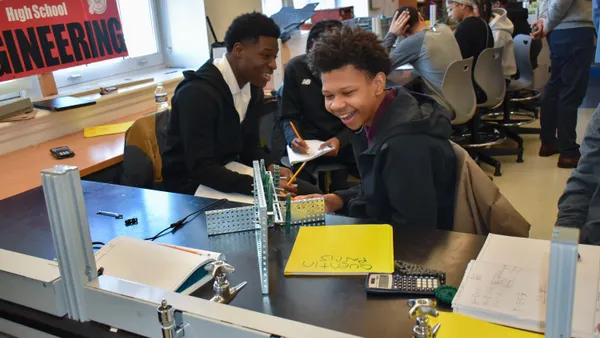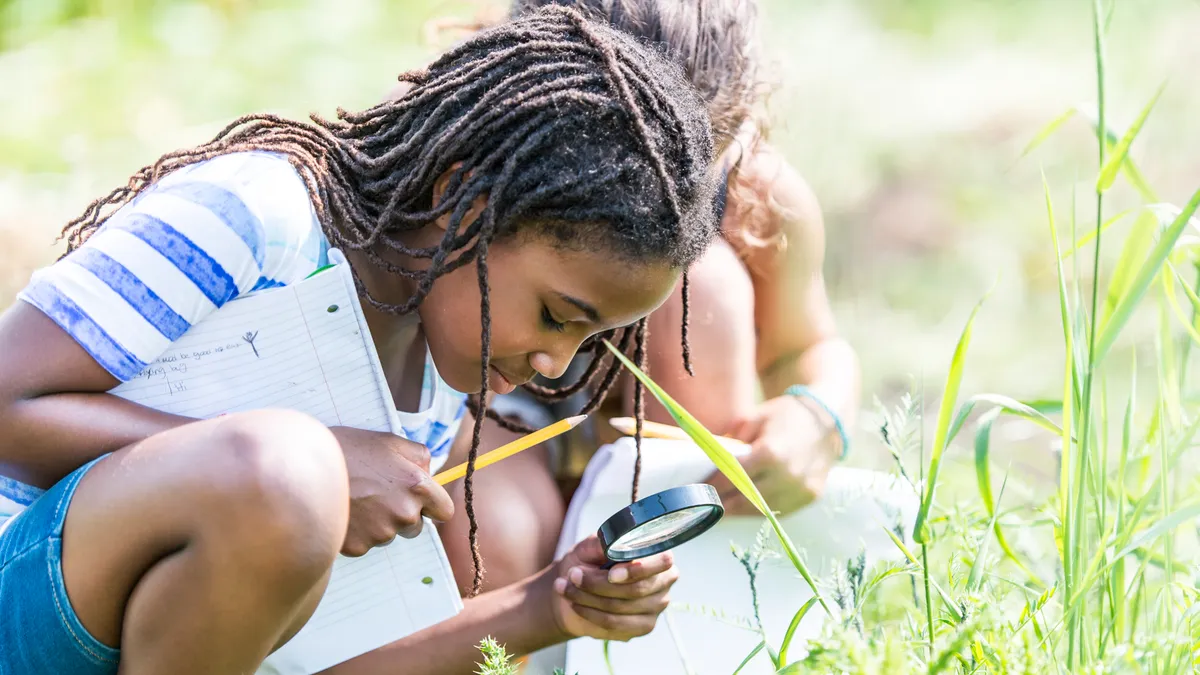
Learning the scientific method provides an essential training ground for critical thinking, evidence-based reasoning, metacognition and decision-making skills that impact students’ education across subjects, according to Travis York, director of the Center for STEMM Education & Workforce at the American Association for the Advancement of Science.
“The cycle of question, investigate, analyze data, conclude, reflect and revise — that ‘reflect and revise’ part is super-important,” he said. The STEMM in the center’s name stands for “science, technology, engineering, math and medicine.”
The scientific method and scientific literacy in general foster habits of mind like how to ask questions, investigate, interpret results and findings, draw logical conclusions, and be open to revisions — all of which are important to success in other subjects and will carry into work, civic engagement and beyond, York said.
“The scientific method gives us an opportunity to have a thinking framework,” he said.
Christine Royce, a past president of the National Science Teaching Association and an education professor and co-director of the master’s in STEM education program at Shippensburg University in Pennsylvania, agrees that asking questions and developing a model lead to critical thinking skills.
“Students have to think through a process, take what they do know, ask questions to figure out more, and reorganize their thinking in a way that helps to answer that original question,” she said.
These kinds of inquiry cycles can be set in motion not just in STEM projects, but also social studies papers that demand evidence backing up a point of view or English essays focused on why a student has certain personal beliefs, York said.
All of these types of assignments “encourage students to document their thinking and revise their hypotheses and conclusions,” he said. “That focuses on not just what did you find, but how did you decide? What was your reasoning? The idea being that when students learn the scientific method, they’re learning how to think — not just what to think. These are skills that carry over into any discipline and any career.”
They’re also important in an age with increasing volumes of information coming at students from multiple sources, so they can suss out where reasoning might not be solid, and where misinformation is being produced as a result, York said.
“This skill of building out how to think and understand claims, evidence and reasoning gives people a powerful structure to reason and revise — to help them navigate a world where they have to be constantly asking, ‘Is this real? Is this not real? What evidence do I have? How reliable is this source?’” he said.
Teachers should start with a video clip or a demonstration that prompts curiosity in students so they’re asking questions from the get-go, Royce said.
“We don’t want them being passive learners,” she said of students. “Teachers can support that process of critical thinking and being genuinely interested in the topic by finding ways to connect to their community, their local environment, things they’re interested in — sports to music to even politics — today.”
Royce also agrees this can apply to other subjects in school or even in day-to-day life.
“We want them asking questions every day. We want them utilizing those higher-order critical thinking skills,” she said. “The process should be iterative. They might go so far down a path and go, ‘You know what? We have more questions. We need to collect more evidence and information.’ They begin to see it’s not a linear path: It’s a cyclical or iterative path.”
York suggests that educators check out a 2024 meta-analysis published in the Journal of Education in Mathematics, Science and Technology, which examined the effects of inquiry-based approaches on students’ science learning, and how it significantly impacts their higher-order thinking skills compared with conventional instruction.
In regard to the skills imparted by these approaches, he said, “This is what we hear college faculty asking for students to have coming in — and what we see employers asking about.”


 Dive Awards