Dive Brief:
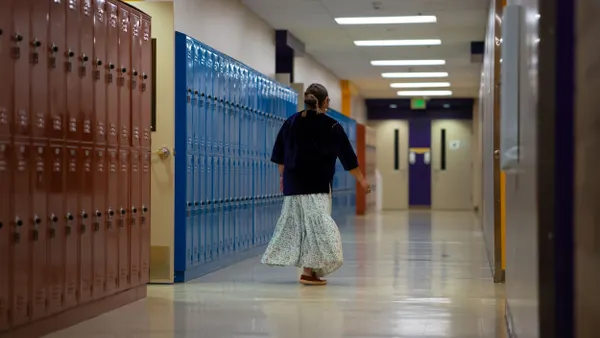
- Successfully infusing artificial intelligence into the classroom means boosting students’ AI literacy without using the tech to offload their thinking. But that requires teachers first getting up to speed on AI through professional development and being intentional about how they design lessons and assignments, according to a pair of teachers who have used ChatGPT in their curriculum.
- “Invest in your own education,” said Coral Riley, an AP computer science teacher at Pine Lake Preparatory in Mooresville, North Carolina. Riley, who has participated in a statewide effort to develop guidelines for educators and who has invested hundreds of hours in learning about AI. "Advocate for asking teachers to get time to train. It does require time.”
- Casey Cuny, who teaches sophomore honors English and a senior mythology and folklore elective at Valencia High School in California — where he was the state’s 2024 Teacher of the Year — agrees with Riley’s assessment. “Some teachers are a little head-in-the-sand about it, not even realizing how much kids are using it,” he said.
Dive Insight:
“I tell teachers, ‘Anything you send home, you have to assume is being AI’d,’” Cuny said. “When teachers do gain AI literacy and learn ChatGPT, they realize, ‘Wow, I need to pay more attention to this.’”
Cuny says he stopped giving homework “years ago” due to research that recommended against it even before AI. Recently, he was reminded why: A senior kept badgering him about why he couldn’t take an in-class writing assignment home — and then, stymied in that request, admitted, “Low-key, Mr. Cuny, this is the first thing I’ve written in three years.”
When Cuny expressed surprise, the student added, “Yeah, I just put it into ChatGPT.”
Riley has been teaching AI and machine learning as part of her course for the past couple of years. She started having students write and test AI models, talking to them about the ethics of its use and how to analyze potential gaps and large language model hallucinations.
Given the potential for cheating, Riley grades students’ process of using prompt engineering to garner outputs from generative AI rather than the final product, she said.
“I had to personally rethink what I was assessing and grading,” Riley said. “A lot of my focus has been on teacher education and using the tools with a small group of students, with parental permission, to analyze what they’re using them for.”
Students in the AP class Riley teaches have the same mixed feelings about AI as teachers and parents. They don’t want it to replace natural learning interactions with teachers, and they say they need guardrails in place.
“But they also have been super-excited about it,” she said. “They have gotten, in general, very comfortable with prompt engineering and getting tools to give them an output they’re happy with. They’re also being cautious and cognizant of the challenges of AI, which is still making errors, and how to work through those.”
Cuny uses ChatGPT as a teaching assistant and also gives students the opportunity to enter prompts and use it as a learning tool.
“If we read something, I give them a prompt like ‘I want you to quiz me. Give me 20 questions, one at a time, based on this text.’ And then I teach them how to upload the text,” he said. “They all know how to use it as a cheating tool. The cheating is off the charts. I do have major worries about that. But I show how to use it as a learning tool.”
Another use case is giving students a debate prompt that students enter and then debate back-and-forth with ChatGPT on a topic before writing an essay about it.
“Then, I have them hand-write the thesis, so I know they wrote it,” Cuny said. “I’m building in stages, doing more pencil and paper than I was prior to the pandemic.”
He’s also requiring students to hand-write notes, “so they’re engaged and listening,” and holding class discussions on a topic after students interact first with ChatGPT and then shut their Chromebooks.
“We have great discussions,” he said. “It bolsters critical thinking, engagement and personalization in ways we could never do before.”



 Dive Awards