Noticing that English learners seemed to be lagging in vocabulary, Jimmie Tyler Brashear Elementary School in Dallas tapped into “text, information, picture,” or TIP, charts — and within two years, 80% of 2nd graders in the bilingual program reached the top tier of the school’s language assessment.
At the impetus of Principal Sonja Barnes, the school joined the nonprofit Holdsworth Center’s Campus Leadership Program in 2022, when most 2nd grade English learners scored in the lower tiers of the assessment. Bilingual teacher Keylah Pineda and her colleagues tried a handful of different ideas before settling on the TIP charts, which also helped Brashear top the district’s average on the state’s STAAR test vocabulary standards.
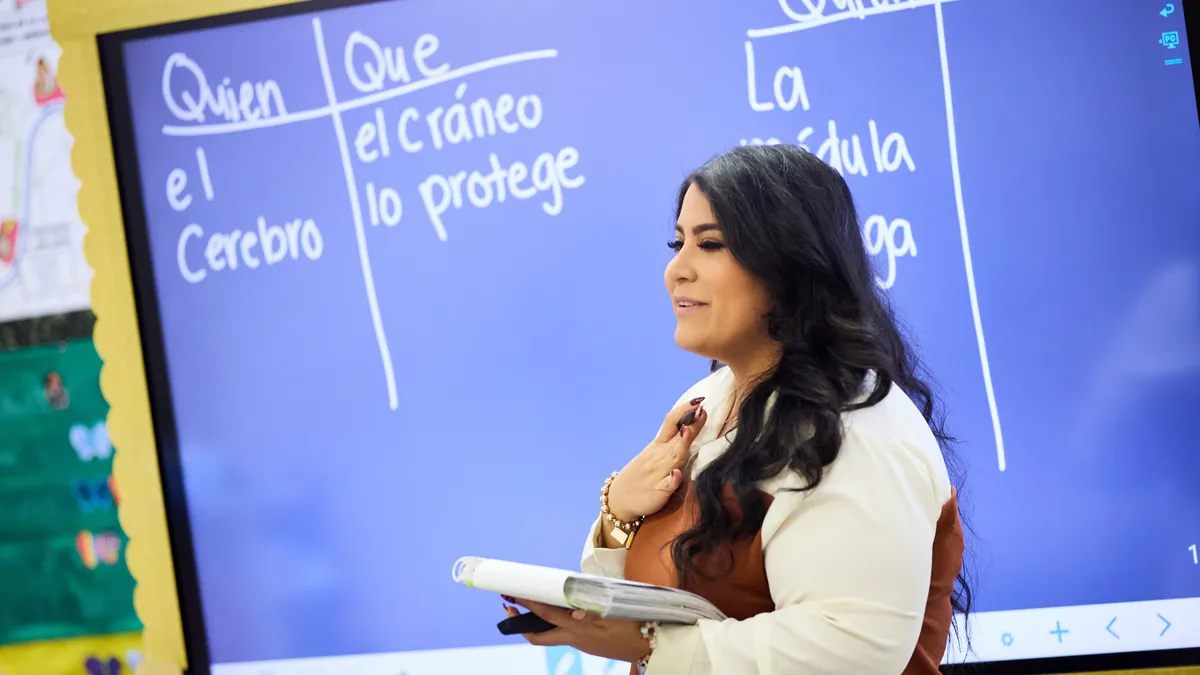
Using TIP charts, students wrote out definitions in their own words, drew a picture of each one, and participated in a movement or gesticulation to help them drive the meaning home.
“We noticed that kids do better when they have visuals,” Pineda said. “And we combined that with kinesthetic movement.”
Charting progress
The use of the TIP charts has spread throughout the school. Pineda now uses it with her 3rd graders, who she said are correctly able to recall the definitions of advanced words like “hemisphere” and “standoffish” and use them correctly in a sentence.
“This is a fun way to learn vocabulary,” Pineda said. “They’re creating their own definition. They’re creating their own picture. It’s a very engaging strategy. Students are able to use these words as they’re learning, both in their conversations and their writing.”
The Holdsworth Center’s resources helped Pineda and her colleagues delve into the issues bilingual learners were having and figure out different strategies through hands-on trials.
“It helped us succeed in elevating the students’ vocabularies,” she said. “We worked on it until we found a solution.”
Holdsworth aims to strengthen public schools by investing in their leaders, and the Campus Leadership Program focuses on principals and members of their teams with professional development around deep data analysis that is ultimately aimed at stronger outcomes for students, said Sharon Foley, managing director of campus programs.
At Brashear, this data analysis led to the progress among bilingual learners. That prompted a series of interviews with both teachers and students to determine what was working well in the classroom and where they were experiencing challenges, along with the opportunity to research best practices that led to the use of the TIP charts, Foley said.
“They come away with a lot of ideas about what they could do differently,” she said. “They start testing those ideas. … Why do we think this idea might work? What are our hypotheses about what might happen when we try this? They then try it and collect data on how it went.”
The Holdsworth Center brings together the 30 to 40 schools that are part of the Campus Leadership Program at any one time to meet and network and learn alongside one another, sharing best practices that might help their colleagues from around the state navigate challenges, Foley said.
“We also bring in expert faculty that are really able to teach knowledge and skills and mindsets that support these leaders,” she said. “We also provide differentiated one-on-one support throughout the program. Each principal, in the first year of the program, is assigned an executive coach. … We also assign each campus a leadership facilitator. That person supports them in the work that we’re highlighting with Brashear around the problem of practice.”